How to Make AI Calorie Estimates More Accurate
Give an AI calorie estimator better inputs with measured amounts, visible portion context, labels, recipe details, and factual corrections.

Chris Raroque
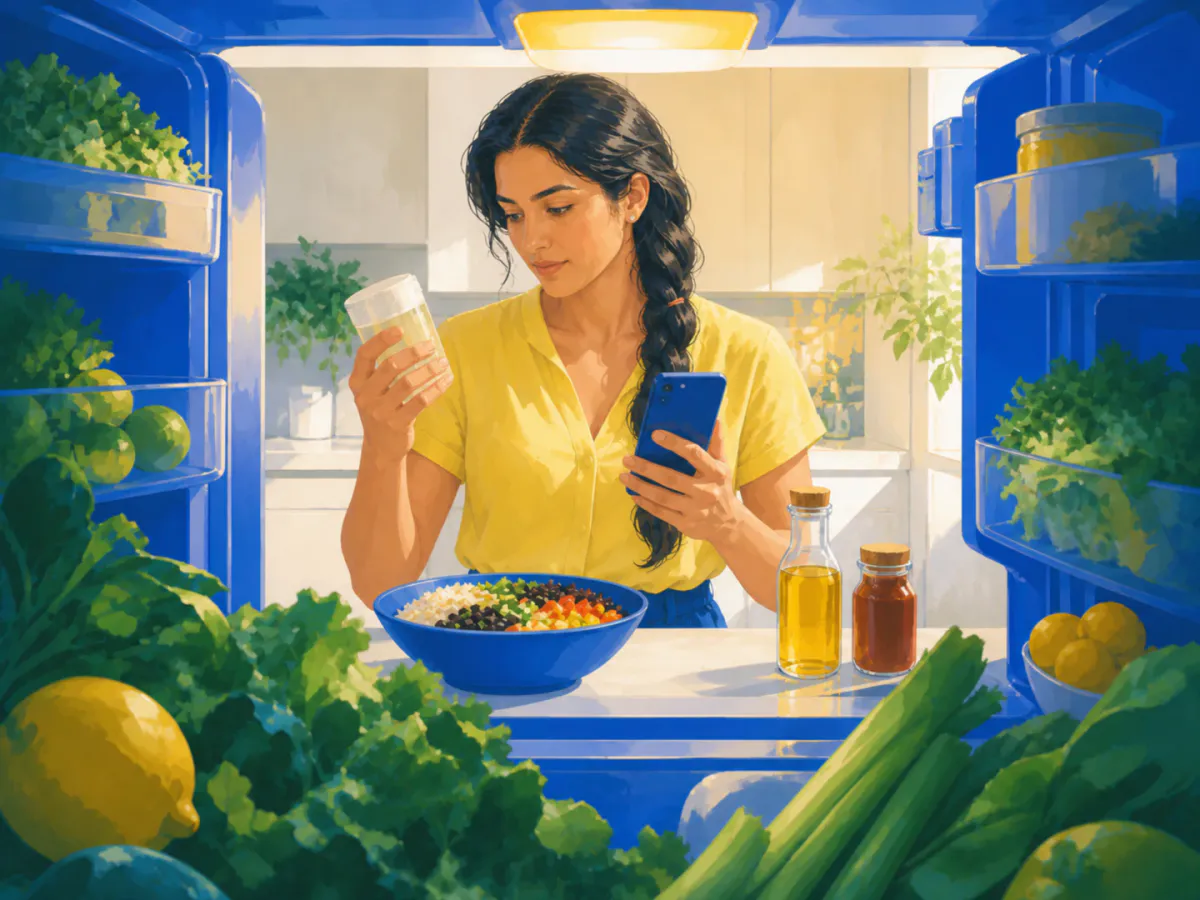
The bowl is already on the table when you notice the bottle beside the stove. You logged “chicken and rice bowl.” The meal also has oil from the pan, a glossy sauce, and rice that was weighed cooked, not dry.
The estimate did not become questionable because you failed to find the perfect prompt. It became questionable because the short description left several different meals possible.
The most useful way to improve an AI calorie estimate is to replace assumptions with facts you actually know: the amount, exact food, raw or cooked state, calorie-dense additions, and recipe information. If you use a photo, make the portion and its container visible, then describe what the camera cannot see. When the app gets a fact wrong, correct that fact instead of asking it to “be more accurate.”
That can make an estimate better grounded. It cannot guarantee that the final number is correct, and these description habits have not been clinically validated as a universal prompt formula.
The short answer
Use this order as a practical checklist, not a research-proven ranking:
- Give an amount you measured or can honestly describe. Use grams, ounces, tablespoons, pieces, a package fraction, or a named restaurant size.
- Name the exact food and its state. Include the brand when a current label exists, and say raw, cooked, drained, skin-on, or skinless when it matters.
- Make photo scale visible. Show the full plate or bowl and keep separate sides and drinks in frame. Add a known plate diameter or vessel capacity in text if you have it.
- Call out hidden additions. Oil, butter, dressing, mayo, glaze, cheese, nuts, and sweetened drinks can be easy to miss in a picture or generic name.
- For homemade food, give recipe and yield information. Ingredient amounts, finished batch weight, and portion weight are stronger than “one bowl of homemade chili.”
- Correct facts, not confidence. Change the wrong amount, food, state, or ingredient. Do not keep rerunning the same vague input until a number feels right.
Use a package label, official restaurant nutrition page, or weighed recipe when it answers the question more directly. AI is most useful when the meal has to be resolved from incomplete information, not when the answer is already printed in front of you.
These habits improve the information going into a system. They do not make a general vision-language model, a consumer calorie tracker, and an app backed by a curated food database equivalent. Each can use different models, records, prompts, and serving assumptions, so a study result for one system is not an accuracy score for another.

Start With An Amount You Can Defend
“A bowl” sounds like a portion, but it does not tell the estimator whether the bowl holds 12 ounces or 32. “A large serving” has the same problem.
Start with the strongest amount you already have:
- a weight from a kitchen scale;
- a labeled package fraction;
- a measured cup, tablespoon, or teaspoon;
- a count plus useful size information;
- a known plate, bowl, or container capacity; or
- the restaurant’s named size.
Here is a description-only before and after:
Before:
Chicken and rice bowlAfter:
180 g cooked white rice and 130 g cooked skinless chicken thigh
The second description is more specific because the amounts and states are known. It is not automatically accurate if the weights were guessed, if the chicken entry does not match the preparation, or if sauce and oil are still missing.
Do not turn an eyeballed portion into 173 g because grams look scientific. If
you know only that you ate half of a 12-ounce package, say exactly that. Honest
coarseness is more useful than invented precision.
If weighing every meal is not realistic, use the lighter workflow in how to track calories without weighing every bite. A one-time check of a repeat bowl or serving spoon can give you better context without putting dinner on trial every night.
Give A Photo Visible Portion Context
A close crop can make a small bowl fill the frame. A top-down image can flatten depth. A mound can hide what sits underneath it. A second angle may show more, but current research does not support promising that more angles improve every system.
For a useful meal photo:
- keep the full rim of the plate or bowl visible;
- avoid an extreme close-up or a distant table shot;
- keep separate sides, toppings, and caloric drinks in frame;
- do not stack packages in front of the food;
- use clear, even light so food boundaries remain visible; and
- add known dimensions in text, such as
10-inch dinner plateor2-cup bowl, when you actually know them.
Research portion-estimation systems often use a physical reference because a 2D photo loses real-world scale. A 2024 CVPR workshop paper used a known physical reference and 3D models for that reason. That specialized pipeline does not prove a consumer app knows the size of your fork. Treat a visible plate and utensil as context, not calibration.
Before: a tight photo showing only the center of a pasta bowl
After: the full bowl, rim, side salad, and drink in one clear frame, plus
pasta is in a 2-cup bowl; about three-quarters full
The text carries the known portion information. The photo carries shape, composition, and what is visibly present. Neither one reveals oil absorbed into the pasta or cream inside the sauce.
Name The Food, Product, And Preparation State
“Protein bar,” “rice,” and “chicken” each map to many possible records. When a package is in your hand, provide the brand, full product name, serving grams, and fraction eaten. Then use the current label’s calorie value rather than asking AI to re-estimate it.
FDA explains that Nutrition Facts values are tied to the displayed serving size, shown as a household measure followed by a metric amount. One package can also contain more than one serving. Check both lines before writing “one bag.” See the FDA’s serving-size guidance.
Preparation state matters because the weight basis changes with water gain, water loss, draining, skin, and edible yield:
Before:
150 g chicken and 180 g riceAfter:
150 g cooked skinless chicken breast and 180 g cooked white rice
Match the database entry to the state in which you weighed the food. USDA FoodData Central includes several data types with different sources and purposes, including analytically derived Foundation Foods, survey-oriented FNDDS foods, manufacturer-supplied Branded Foods, and historical SR Legacy records. A detailed description can still reach the wrong record, so inspect the selected source when the tool exposes it.
For a deeper explanation of source, serving, and raw-versus-cooked differences, see why calories differ between apps.
Bring Oil, Dressing, And Sauces Into The Sentence
The camera sees a sheen. It does not know whether that sheen is water, one teaspoon of oil, or several tablespoons shared across a batch.
Name calorie-dense additions separately and use the amount that went into your portion when you know it:
Before:
Grilled chicken salad with dressingAfter:
2 cups romaine, 140 g cooked grilled chicken, 2 tablespoons bottled ranch from the current label, 1 tablespoon grated parmesan; chicken was cooked with 2 teaspoons olive oil and nearly all was served
This example describes the information; it does not report a tested calorie change.
If the oil was shared across four servings, say that. If much of it remained in
the pan, say that. If the amount is unknown, write oil used, amount unknown
instead of silently choosing a tablespoon. A transparent range can be more
honest than one exact-looking result built on an invisible guess.
Also separate the drink. “Lunch” can quietly exclude a sweetened coffee, smoothie, beer, or refill when the image and description focus on the plate.
Give Homemade Food A Recipe And A Yield
A dish name is not a recipe. “Homemade chili” could be mostly beans and tomatoes, heavy on meat and oil, or topped with cheese and sour cream.
For a one-off meal, list the few ingredients that define it. For a repeated meal, keep a batch record:
- Record each ingredient and amount before cooking.
- Use current labels for branded ingredients.
- Record oil, broth, sauces, and toppings.
- Weigh the finished edible batch when practical.
- Weigh your portion or record the fraction served.
- Keep toppings that were added per bowl outside the shared batch.
Here is an illustrative input structure, not a tested recipe or result:
Before:
About 2 cups homemade turkey chiliAfter:
340 g serving from a 2,040 g finished batch. Full batch: 680 g 93% lean ground turkey, two 15-ounce cans of beans drained, one 28-ounce can of tomatoes, 1 tablespoon olive oil, onion, and spices. My bowl also had 28 g shredded cheese.
The finished weight matters because cooking changes batch mass through water and sometimes discarded fat or liquid, not because every ingredient loses calories by a fixed multiplier. A traceable batch calculation is stronger than asking AI to reconstruct the same chili from its name each week. Use the recipe calorie calculator for that job.
Correct The Fact That Is Wrong
The first estimate is a draft. Review it while the meal, label, and measuring spoon are still nearby.
Check four things:
- Did it identify the food or product correctly?
- Did it use the amount you ate?
- Did it match raw, cooked, drained, or skin state?
- Did it include the oil, sauce, toppings, sides, and drink?
Then make a factual correction:
| Weak correction | Better factual correction |
|---|---|
Be more accurate. | Change the rice to 180 g cooked white rice. |
That seems too low. | Add 2 teaspoons olive oil used for my portion. |
Try again. | Keep the chicken and rice; remove the cheese you assumed. |
Use a bigger serving. | The soup was 14 fluid ounces in this container. |
The package says something else. | I ate the full package. The label says 2 servings, and each serving is 190 calories. |
If you are diagnosing one surprising mismatch, change one disputed fact at a
time so you can see what moved. If several facts are plainly wrong, correct them
together; there is no benefit in preserving known errors as a ritual. Do not
keep rerolling an unchanged description until the estimate agrees with your
mood. When the tool lets you save a corrected food or recipe, give it a useful
name such as home chili, September batch or current package, 42 g.
Disclosure: I created Amy Food Journal, which is built around plain-language entries and editing. I am mentioning it because this correction workflow fits that interface, not because this article tested Amy or found it more accurate than another tool. The same habit applies in any tracker that lets you revise a meal.
The correction habit does not train every AI system or guarantee a better model answer. Its dependable value is smaller: your saved record now contains the facts you know, so tomorrow’s entry does not have to repeat today’s ambiguity.
What Current Research Can And Cannot Tell Us
Evidence status: Published research, not an app score. The studies below test specific models, photos, prompts, and populations. This article did not run a current product benchmark.
AI nutrition studies do not give us one accuracy percentage for every app, model, meal, and input style.
In a 2025 study of three multimodal language models, researchers used 52 standardized food photographs at three portion sizes. The images included visible cutlery and plates as size references. ChatGPT-4o and Claude 3.5 Sonnet each had a reported mean absolute percentage error of 35.8% for energy, and all three tested models underestimated more as portions grew. That is a result for those models, images, prompts, and reference foods. It is not a current score for every AI calorie tracker.
A 2026 Scientific Reports study evaluated 40 vision-language models and then tested a smaller model subset across additional angles, seven prompt strategies, and ingredient-description conditions. In that experiment, extra image angles did not improve the aggregate result, and prompt strategy did not have a significant overall effect after correction. Ingredient descriptions produced a small average improvement, but the response varied by model and some results worsened.
Nature currently labels that paper an early, unedited manuscript. Its details may change before the final version, so this guide treats it as useful current evidence rather than the last word.
That is the right level of confidence for this guide. Specific known information may remove a real ambiguity. More elaborate wording, extra angles, or a confident tone do not automatically improve an estimate. None of these studies clinically validates the template below.
For the broader evidence and limitations, read how accurate AI calorie counting is. For the choice between input methods, see text versus photo calorie tracking.
Know When To Stop Asking AI
Switch tools when a stronger source is available:
| Situation | Better first source |
|---|---|
| Current packaged food | The package’s Nutrition Facts label and amount eaten |
| Standard chain-restaurant item | The restaurant’s current official nutrition page or builder |
| Repeated homemade recipe | Ingredient records, finished batch weight, and portion weight |
| Basic weighed food | A documented database entry matching the food and preparation state |
| Mixed meal with no recipe or label | A transparent estimate or range with the important assumptions stated |
| Medical decision requiring precise intake | A qualified clinician and an appropriate validated method |
The clinical boundary is real. In a 2026 seven-day validation study of one image-based system in 20 women with obesity, individual agreement with doubly labeled water was poor. That result does not score every app or population. It does show why a consumer estimate should not be quietly promoted into a clinically validated measurement.
In the separate 2026 vision-language-model evaluation cited earlier, professional dietitians outperformed every tested system, particularly for protein. Human expertise is not infallible, but that result is another reason to switch methods when precision matters instead of asking the same consumer estimator again.
An estimate is useful when it is honest enough for the decision in front of you. Once the label or recipe already answers the question, more prompting usually adds ceremony rather than evidence.
A Description Template You Can Actually Use
Include only fields you know:
[measured amount or honest portion] of [food or exact product],
[raw/cooked/drained/skin state], prepared with [fat and amount].
Also included [sauce, dressing, toppings, sides, and drinks with amounts].
For a mixed dish: [main ingredients] from [portion weight or batch fraction].
For a photo, add:
The full meal is visible on a [known plate or bowl size].
The photo does not show [oil, sauce, filling, or other hidden ingredient].
Three natural examples:
180 g cooked white rice, 130 g cooked chicken thigh, and 2 teaspoons
olive oil used for my portion, with 1 tablespoon bottled teriyaki sauce.
One full 52 g bar of [brand and product]. Use the current label:
one bar is one serving.340 g of my saved turkey chili batch, plus 28 g shredded cheese.
Use the batch recipe and finished weight, not a generic chili entry.You do not need to type every field for every meal. The goal is a short record that resolves the uncertainty you can resolve.
Frequently Asked Questions
Does a longer prompt make an AI calorie estimate more accurate?
Not automatically. In one 2026 study, seven prompt strategies did not produce a significant overall improvement after correction. Add facts that narrow the food or portion, not role-play, confidence language, or decorative prose.
Does adding grams make the estimate accurate?
Only if the grams were measured and matched to the correct food state. A guessed weight remains a guess even when it has three digits.
Should I put a reference object in a food photo?
A full plate, bowl, and utensil can provide visible context, and specialized research systems use known physical references to recover scale. Do not assume every consumer model recognizes an arbitrary object or its dimensions. State a known plate diameter, vessel capacity, or measured weight in text when possible.
What if I do not know how much oil or sauce was used?
Say that it was present and the amount is unknown. Ask for a range if the tool supports one, or compare plausible amounts yourself. Do not invent a tablespoon just to make the output look complete.
Why does the estimate still look wrong after I add detail?
The system may have selected the wrong database record, misunderstood the recipe, or made a portion assumption you did not remove. Inspect its component foods when possible. Correct the specific mismatch, and switch to a label, official menu, or recipe calculation when one is available.
Should I tell the AI the calories from the label?
You can, but the label is already the stronger source. Record the label value for the amount eaten and use AI only to organize the entry. There is no benefit in asking a model to overrule known current package information.
Better Evidence, Not A Better-Sounding Prompt
The useful version of an AI meal description is not the longest one. It is the one that says what you know and leaves the unknowns visible.
Measure when it is easy. Show the whole portion. Name the product and state. Pull oil and sauce out of the background. Save a real recipe for the meals you repeat. Correct facts instead of negotiating with the number.
That will not make every estimate right. It will make the estimate easier to inspect, explain, and improve without pretending uncertainty disappeared.
Keep Reading
All articlesGuides
Best Calorie Trackers for Homemade Meals Without Fake Precision
Compare calorie trackers for homemade meals and choose cooked yield, equal servings, or an honest estimate—without inventing precision.
Guides
How Accurate Is Apple Watch Calorie Tracking? (What the Data Shows)
Studies show Apple Watch calorie tracking is off by 20-40%. See the research, what affects accuracy, and how to pair it with food tracking.
Guides
Calorie Tracker Apps That Sync With Apple Health
Compare six calorie trackers by documented Apple Health read and write support, Dietary Energy, macros, history, and duplicate-data risk.
Guides
Does Apple Health Track Calories Eaten?
Apple Health can store calories eaten as Dietary Energy, but it does not identify meals. Learn how to view, add, and trace each value.