How to Track Calories Without Weighing Food
Track calories without weighing every bite using labels, repeat portions, recipe math, honest ranges, and one simple five-minute calibration.

Chris Raroque
Updated
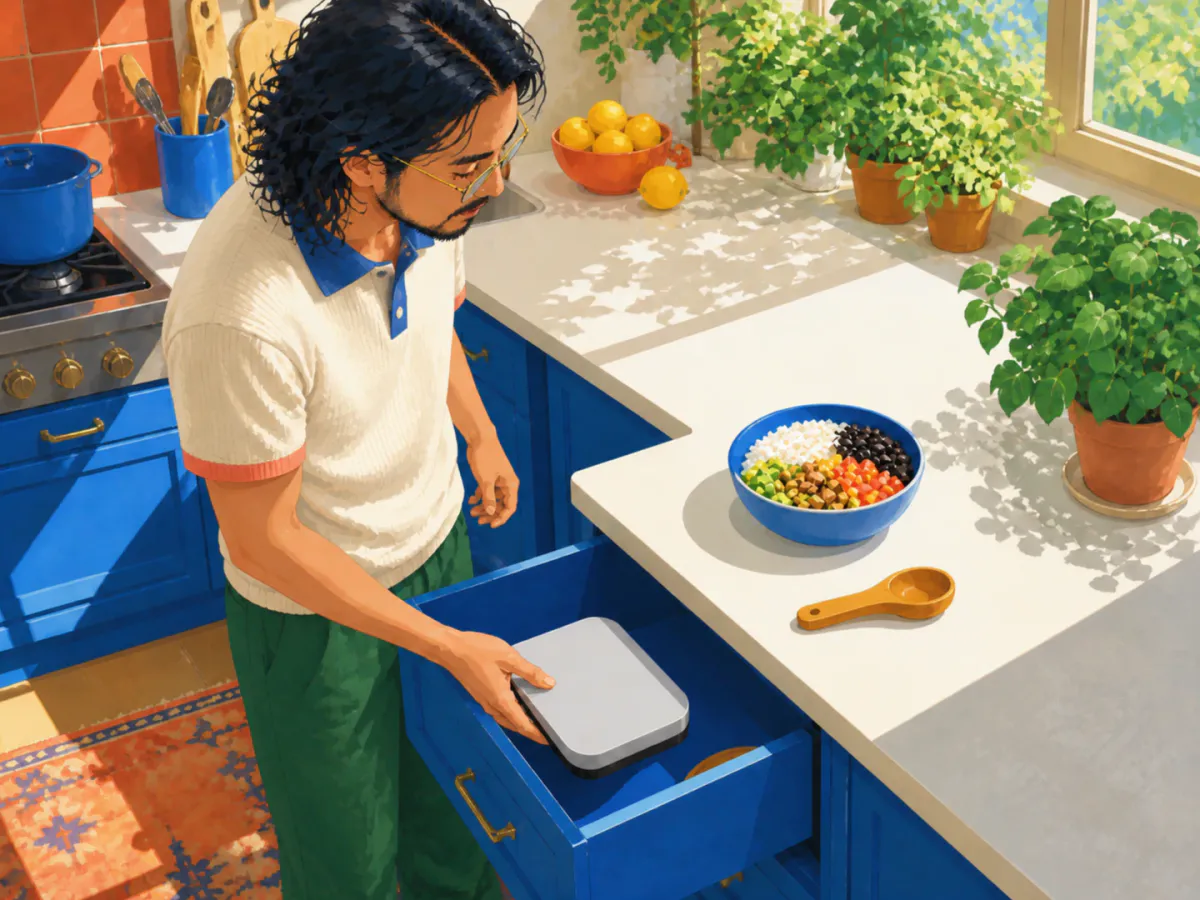
The hardest meal to track is rarely the yogurt with a label. It is dinner at someone else’s house, when rice is already under the curry, the serving spoon is back in the kitchen, and asking for a scale would make a normal evening feel like a science practical.
You do not have to choose between weighing everything and inventing a number.
The useful middle is to be exact when exact information is already available, learn a few portions you repeat, and use a range when the meal cannot support a single answer.
The short answer
Use the lightest of four methods that fits the food:
- Use exact information that already exists. Start with the package, piece count, or current official menu value.
- Learn one repeat cue. Check the bowl, scoop, glass, or spoon you use often, then save a personal reference.
- Use a range when the meal is genuinely uncertain. Name the ingredient or portion creating the range.
- Stop when more detail would not change a decision. One imperfect meal does not need a miniature investigation.
This creates a useful estimate, not a laboratory measurement. If you need the complete beginner workflow, start with How to Track Calories Without Making It Your Whole Life. This guide is about the narrower problem of portions.
Give each meal only the work it needs
Some foods arrive with strong evidence. Others arrive as a bowl assembled by somebody who was not thinking about your food log.
Use the strongest source that is already available:
| What you have | Best starting point | What to record |
|---|---|---|
| A whole single-serve package | The exact Nutrition Facts label | Product, container, and whether you ate all of it |
| A countable packaged food | The exact label’s unit | Number of pieces, slices, bars, or tortillas |
| A repeat homemade recipe | Whole-batch ingredients and cooked yield | Recipe version and familiar serving vessel |
| A familiar loose food | A personally checked scoop, bowl, or pour | The cue you can reproduce and its range |
| A restaurant or shared meal | Official information plus visible components | Known items, substitutions, and low/high assumptions |
| A meal remembered later | A plain description and an honest range | Major ingredients and the dominant uncertainty |
The FDA explains that a labeled serving size reflects the amount people typically consume, not a recommendation. Your portion can be larger or smaller. The label is useful because it gives you a conversion, not because it tells you how much you should eat.
Start with what is already exact enough
If you ate the whole yogurt cup, use the whole cup. If the label says one tortilla and you ate two, use two. If a frozen meal has a dual-column label for one serving and the whole package, choose the column that matches what you ate.
This sounds obvious, but calorie apps often introduce a new opportunity for error: the first search result may describe a different package size, brand, or preparation. When the package is in your hand, the package wins.
For an unpackaged food, USDA FoodData Central can be a useful source. Check the description, cooked or raw state, household measure, and data type. “Chicken breast” is not specific enough if one entry includes skin and another does not.
Countable units are especially useful because they remove a conversion. One retained package label for the exact slice of bread is usually better than a generic database average for “one slice.”
Give one recurring portion a five-minute calibration
The most useful food to check is not necessarily the food with the most calories. It is a food you eat often, serve inconsistently, and spend time second-guessing.
Try this with one food:
- Serve the amount you would normally eat before looking at a scale or measuring cup.
- Describe the cue in language you will recognize: “blue bowl to the ridge,” “one level rice scoop,” or “thin layer across one slice.”
- Check the portion once using the exact label’s gram amount, an actual measuring cup or spoon, or an optional kitchen scale.
- Do the label arithmetic.
- Save either one reference or a small range.
- Recheck only if the product, recipe, vessel, or way you serve it changes.
One check does not validate your eye. It creates a personal reference for one recurring situation.
What a saved reference looks like
Use your actual product and your actual scoop; this draft does not substitute invented measurements for that check. Save only what you observed:
Food: [exact product or recipe]
Repeat cue: [blue bowl to the ridge / one level scoop]
Checked amount: [your observed amount]
Source: [package / recipe / documented database record]
Working range: [only if repeated checks actually varied]
Recheck when: [product, recipe, vessel, or serving habit changes]
This works for cereal, rice, dressing, nuts, nut butter, cheese, or another repeat portion that regularly creates uncertainty. It is a personal reference, not a universal portion chart.

Use the vessel you actually live with
“One bowl” is meaningless across households. Your blue breakfast bowl can still become a useful cue after you learn what it holds.
You can check a bowl with water and a measuring cup, fill it to a repeatable line, or weigh one ordinary serving. A ladle can be checked against a measuring cup. A dressing spoon can be compared with the exact product’s labeled tablespoon or gram amount.
The resulting note should stay personal:
- one level blue scoop of cooked rice;
- cereal to the lower ridge of the white bowl;
- one ladle of the saved lentil soup;
- half of the short leftovers container.
That is less universal than “a fist is a cup,” and much more likely to be reproducible in your kitchen.
Save a recipe once, then stop rebuilding it
For chili, soup, pasta sauce, curry, or another meal you repeat, save the whole recipe rather than searching for a generic bowl every time.
The basic method is:
- add the calories from the actual ingredients used;
- record the cooked edible yield;
- divide the batch calories by the cooked yield;
- use that rate for a familiar container, ladle, or serving range.
The batch calculation
Use the actual ingredient total and finished edible yield from the recipe you made:
estimated calories per cooked gram
= estimated calories in the edible batch / final cooked edible grams

estimated portion calories
= cooked grams eaten x estimated calories per cooked gram
If you do not have the ingredients or finished yield, this calculation is unavailable. Use a rounded estimate or range instead of supplying invented batch values.
Water is why the cooked yield matters. A soup can gain weight from water without gaining calories; roasted food can lose water without losing the calories already in the ingredients.
For a one-off dinner, this may be more work than the answer deserves. Use recipe math when it will save effort later.
Let a range be the answer
A restaurant bowl can look precise in an app because the app returns one number. That does not mean the meal supplied one number’s worth of evidence.
Start with the parts you can defend:
- Use the restaurant’s current official value if it matches the item and size.
- Note substitutions and add-ons.
- Separate the ingredients that create most of the uncertainty.
- Build a low and high case from explicit assumptions.
- Keep the range visible.
Build the note from the evidence you actually have:
Known components: [current official values or documented records]
Main portion range: [the rice, fries, or other meaningful uncertainty]
Sauce or oil range: [only when the source or amount is uncertain]
Working meal range: [rounded total from those sourced cases]
The useful finding is which component drives the spread. Identifying the lettuce variety will not rescue an estimate dominated by rice and sauce. Keep the range visible rather than reporting only an unsupported midpoint or adding one automatic percentage to the meal.
At a shared table, the same rule applies. Describe what you ate, name the important unknown, choose a defensible range, and move on.
Photos help you remember; they do not measure depth
A photo can preserve details you would otherwise forget: the second sauce cup, the drink, the size of the plate, or whether the rice was underneath the protein.
If a meal is worth documenting, one photo can preserve the plate, drink, sauce, and leftovers. A second angle at roughly 45 degrees is optional when height or bowl depth is an important unknown. Keep the bowl, plate, or utensil in frame for context.
The image still cannot reveal an unmentioned oil pour, recipe quantities, or the weight of food hidden underneath. A photo-based app can suggest a first estimate, but you should treat it as a draft. Our review of AI calorie-counting accuracy explains why portion and ingredient context matter.
What portion research actually supports
Hand portions, food photos, and household measures can all be useful. None is a universal ruler.
In a 2025 study, 1,081 free-living Japanese adults recorded 12,148 meals with both weighed amounts and hand-based portions. The number of fists, palms, or handfuls was moderately to strongly correlated with the amount eaten across four food groups. But the resulting models explained 34% to 65% of the variation and still had wide limits of agreement. That makes the hand scale a plausible shorthand in that population and setting, not a promise that your fist equals one fixed weight or calorie count.
Photos have similar boundaries. A 2025 experiment with 82 adults found that portion estimates changed with the food and camera angle; combining angles improved results for most of the six foods, while soup remained harder to judge. The study was a controlled matching task, not proof that two phone photos reveal hidden oil or the exact depth of every bowl. Its useful lesson is simply that one flat view leaves information out.
Even experience does not turn a photo into ground truth. In a smaller 2018 study of 38 nutrition professionals, fewer than one-third estimated the portions in either of two meal images within 10% of the measured weight. The errors also differed by item.
The practical conclusion is smaller than a universal accuracy claim: use the best evidence available for this food, in this vessel, today.
Spend attention where it can change the answer
The same gram error has a larger calorie effect in a more energy-dense food. That is arithmetic, not a judgment about the food.
Oil, dressing, nuts, nut butter, granola, cheese, and some sauces can be worth checking when they are both frequent and uncertain. Rice, pasta, cereal, and homemade leftovers can be worth checking when your serving vessel changes a lot.
You do not need to inspect all of them. Pick the one or two details that create most of the range in your own log.
Then use a stopping question:
Would narrowing this estimate change what I do with the information?
If the answer is no, the extra measurement is probably not buying you much.
A scale can still be the easier tool
Not weighing every bite does not require banning the scale.
A scale may be the lowest-friction answer when:
- you are dividing a repeat batch;
- a label gives calories by grams but no useful household unit;
- a portion keeps surprising you;
- one measurement will create a reusable bowl or scoop reference;
- a clinician has asked you to record intake in a specific way.
Use it to answer a question. Then put it away when the question is answered.
When tracking is not the right tool
Calorie tracking is optional, and it is not emotionally neutral for everyone.
The National Institute of Mental Health says that becoming fixated or obsessed with weight loss, body weight or shape, and controlling food intake may be signs of an eating disorder. Eating disorders are serious illnesses, and early treatment matters.
That guidance does not mean one difficult meal or one anxious thought proves a diagnosis. As a practical safety rule, pause tracking and talk with a qualified clinician, registered dietitian, or therapist if logging is increasing fear around uncertain meals, social-food avoidance, compulsive rechecking, compensatory behavior, or pressure to keep lowering intake regardless of hunger and health. If you already have an eating-disorder history or a clinician-directed nutrition plan, follow your care team’s advice rather than a generic calibration exercise.
If numbers are not useful for you, a descriptive journal can still help you notice meals, hunger, context, and patterns. How to Start a Food Journal covers that gentler approach.
A brief note about Amy
I created Amy Food Journal, and this site publishes it. Amy lets you type a meal in ordinary language, which can make a rough or range-based log easier to start. It cannot see an oil pour you did not mention or know the size of an unfamiliar bowl. The description and your review still matter.
If typing is the habit you are most likely to keep, see the easiest calorie tracker guide or learn more about Amy.
The real decision
Keep precision where it comes cheaply: the package in your hand, the countable item, and the recipe you will eat again.
Calibrate the bowl or scoop that repeatedly creates uncertainty. Give shared and restaurant meals a range. Let one imperfect dinner remain one imperfect estimate.
The scale can teach you something without becoming a permanent dinner guest.
Frequently asked questions
Can calorie tracking be useful without a food scale?
Yes, as an estimate. Exact labels, countable units, familiar vessels, saved recipes, official menu information, and explicit ranges can all support a useful log. The uncertainty depends on the food and the question you want the log to answer.
Are hand portions accurate?
Hand portions can be convenient shorthand, but a palm, fist, or handful does not equal one universal weight. A large 2025 free-living study found meaningful relationships between hand-based portions and weighed amounts, alongside wide individual agreement limits and important population and food-group constraints. Treat a hand cue as approximate unless you have checked it for your recurring food.
What should I calibrate first?
Choose one food you eat often, serve inconsistently, and spend time second-guessing. A dressing pour, granola scoop, cereal bowl, rice scoop, or repeat leftovers container may be more useful than checking a food you rarely eat.
How do I track a homemade meal without weighing every serving?
Calculate the whole batch once, record the cooked yield, and check one familiar ladle, bowl, or container. Save a range if the fill level varies. Recalculate when the recipe or yield changes materially.
What if I do not know how much oil or sauce was used?
Use low and high cases based on explicit, plausible amounts and keep the range. Do not add one universal restaurant buffer. If oil or sauce is a frequent uncertainty in your own cooking, check your usual pour once.
Can an AI photo app estimate the portion for me?
It can propose an estimate, but a flat image may not reveal depth, hidden ingredients, cooking fat, or recipe quantities. Two angles and a useful description provide more context, but the result still needs review.
Keep Reading
All articlesGuides
How to Count Calories at Restaurants Without Nutrition Information
Estimate restaurant calories without nutrition facts by matching components, using official or USDA anchors, and keeping an honest working range.
Guides
How to Track Calories: A Beginner's Guide That Stays Practical
Learn how to track calories without chasing perfect numbers. Set a starting target, log ordinary meals, handle portions, and build a repeatable first week.
Guides
Best Calorie Trackers for Homemade Meals Without Fake Precision
Compare calorie trackers for homemade meals and choose cooked yield, equal servings, or an honest estimate—without inventing precision.
Guides
Does Apple Health Track Calories Eaten?
Apple Health can store calories eaten as Dietary Energy, but it does not identify meals. Learn how to view, add, and trace each value.