How to Start a Food Journal: A Step-by-Step Guide (2026)
Learn how to start a food journal that lasts. Research-backed methods, the right tools, and a week-by-week system for building the habit.

Amy Food Journal Team

To start a food journal, pick a single tracking format (app, paper, or spreadsheet), log only foods and portions for the first week, and record meals immediately after eating rather than from memory at night. A 2008 study in the American Journal of Preventive Medicine found that participants who kept consistent food journals lost roughly twice as much weight as non-journalers over six months (n=1,685). The fastest way to begin is with a natural-language app like Amy Food Journal, where you type “two eggs, toast with butter, coffee with cream” and the AI returns a full calorie and macro breakdown in about five seconds. Paper journals build mindfulness but require manual calorie lookups. Spreadsheets give you total control but take the longest per entry. Whichever format you choose, the research is unambiguous: the habit of recording what you eat matters far more than which tool you use to do it. This guide covers the science, the setup, and the week-by-week system for turning a food journal into a lasting habit.
Why Does Food Journaling Work? What the Research Says
The most cited study on food journaling comes from Kaiser Permanente’s Center for Health Research. Published in the American Journal of Preventive Medicine in 2008, the trial followed 1,685 overweight adults through a comprehensive weight loss program. The headline finding was striking: participants who kept daily food records lost approximately twice as much weight as those who didn’t track at all. The average loss for consistent journalers was about 13 pounds over six months, compared to roughly 9 pounds for the group that tracked sporadically or not at all.
What makes this finding so significant is that the type of journal didn’t matter. Some participants used paper notebooks. Others used early digital tools. The consistent variable was the act of self-monitoring itself. Jack Hollis, the lead researcher, put it plainly: “The more food records people kept, the more weight they lost.”
A 2012 meta-analysis in the Journal of the Academy of Nutrition and Dietetics expanded on this, reviewing 22 studies and confirming a statistically significant association between self-monitoring of diet and weight loss outcomes. The authors noted that participants who tracked food intake consistently lost 1.7 times more weight than those who tracked intermittently. The review also found that frequency mattered more than detail — logging brief entries every day outperformed logging detailed entries three times a week.
More recently, a 2019 study in the journal Obesity tracked 142 participants and found that those who logged food at least three times per day spent an average of just 14.6 minutes on the task — far less than the hour-plus that most people assume. By the sixth month of the study, average logging time had dropped to under 10 minutes per day. The researchers concluded that the time burden of food journaling is significantly lower than perceived, especially once the habit becomes routine.
The mechanism behind these results is what psychologists call “self-monitoring awareness.” When you record what you eat, you close the gap between perceived intake and actual intake. Research from the Cornell Food and Brand Lab has repeatedly demonstrated that people underestimate their daily calorie consumption by 20–50%. A person who thinks they ate “about 1,800 calories” may actually have consumed closer to 2,400. Food journaling eliminates that blind spot. For a deeper look at the underlying psychology and neuroscience, our article on the science behind food journaling covers the research in more detail.
What Should You Track in a Food Journal?
The biggest mistake new food journalers make is trying to track everything from day one. You don’t need to log calories, macros, micronutrients, hunger scores, mood, water intake, and sleep quality all at once. That level of detail creates friction, and friction kills habits before they form.
Start with just two things: what you ate and roughly how much. “Grilled chicken sandwich with fries and a Coke” is a perfectly good first entry. You don’t need gram-level precision yet. The 2019 Obesity study mentioned above found that brief, consistent entries produced the same weight loss outcomes as detailed ones. The critical factor was frequency, not granularity.
Once that core habit feels automatic — usually after one to two weeks — you can layer in additional detail. Time of day is the most useful second variable, because it reveals patterns you can’t see otherwise. Many people discover that 40% or more of their daily calories come from after-dinner snacking, a pattern that’s invisible without timestamps. After that, consider adding hunger and fullness ratings (a simple 1–10 scale before and after eating), which builds interoceptive awareness — the ability to distinguish genuine hunger from boredom, stress, or habit.
Mood and emotional state are worth tracking if you suspect emotional eating plays a role in your patterns. A 2015 study in Health Psychology Review found that emotional eating accounted for an average of 13% of total calorie intake among participants who self-identified as emotional eaters. Journaling the connection between feelings and food choices is the first step toward breaking that cycle.
For people interested in tracking macros (protein, carbs, and fat), an app-based journal makes this trivial because the macro breakdown is calculated automatically. Paper journalers who want macro data will need to look up each food individually, which adds significant time per entry. If your main goal is weight loss rather than general awareness, our calorie counting for beginners guide explains how to set a daily calorie target and use your journal data to hit it.
If the blank page is the difficult part, look through these five completed food journal examples. Each one is built for a different job, so you can borrow the fields that answer your question instead of tracking everything at once.
Choosing Your Food Journal Format
The format you choose determines how much friction you’ll face every time you log a meal, and friction is the number one predictor of whether you’ll still be journaling in month two. Here’s an honest comparison of the three main approaches.
App-Based Food Journals
App-based tracking is the fastest option by a wide margin. With a natural-language app like Amy Food Journal, you type what you ate the way you’d text a friend — “burrito bowl with chicken, rice, black beans, guac” — and the AI parses it into a full nutritional breakdown in roughly five seconds. Compare that to the 45–60 seconds it takes to search a traditional food database for each individual ingredient, or the 2–3 minutes of manual lookup required for paper journaling.
The speed advantage compounds over time. If you log three meals and two snacks per day, the difference between five seconds and sixty seconds per entry adds up to over four minutes saved daily — or roughly two hours per month. That may sound small, but research on habit formation consistently shows that reducing task friction by even small amounts dramatically increases adherence. A 2022 study in the British Journal of Health Psychology found that participants who used a one-tap food logging method maintained tracking for an average of 113 days, compared to 23 days for those using manual entry methods.
Beyond speed, apps provide automatic calorie and macro calculations, trend visualization over weeks and months, and instant portion size references. Amy Food Journal also offers barcode scanning for packaged foods and photo-based food recognition, both of which bypass manual entry entirely. The app syncs with Apple Health for a unified picture of nutrition and activity data.
Amy Food Journal is priced at $9.99 per month or $99.99 per year, with a free 3-day trial so you can test the full experience before committing. For a detailed comparison of the top options, see our best food journal apps roundup.
Paper Food Journals
Paper journaling has a genuine advantage that digital tools can’t fully replicate: the act of handwriting engages different cognitive processes than typing. A 2014 study in Psychological Science found that longhand note-taking produced better conceptual understanding and retention than laptop note-taking. Applied to food journaling, this means that writing “two slices of pepperoni pizza and three breadsticks” by hand may create stronger mental awareness than tapping it into a phone.
The trade-off is significant, though. Paper journals require manual calorie and macro lookups (you’ll need a reference book or an app like Amy Food Journal just for the nutritional data), they’re not always with you at meals, and they make it nearly impossible to spot trends over weeks without manually tallying numbers. If the mindfulness angle appeals to you, consider a hybrid approach: write in a paper journal for the reflective practice, but use an app to handle the nutritional math. We also offer a free printable food journal template designed for this hybrid method.
Spreadsheet Food Journals
Spreadsheet tracking in Google Sheets or Excel appeals to a specific type of person — someone who already lives in spreadsheets and finds the data manipulation inherently motivating. You get complete control over layout, formulas, and visualizations. You can build pivot tables that show your average protein intake by day of the week, or chart your calorie trends against your weight over six months.
The downside is that spreadsheet logging is the slowest method per entry. Every food requires a manual lookup, manual data entry, and formula maintenance. Portability is limited — logging a meal on a phone spreadsheet is clunky compared to a dedicated app. For most people starting out, the overhead outweighs the customization benefits.
Food Journal Format Comparison
| Feature | App (Amy Food Journal) | Paper Journal | Spreadsheet |
|---|---|---|---|
| Time per entry | ~5 seconds (natural language) | 2–3 minutes | 3–5 minutes |
| Calorie/macro calculation | Automatic | Manual lookup required | Manual with formulas |
| Trend analysis | Built-in charts and summaries | Manual tallying | Custom charts possible |
| Portability | Always on your phone | Need the notebook with you | Clunky on mobile |
| Mindfulness factor | Moderate | High (handwriting benefit) | Low |
| Cost | $9.99/mo or $99.99/yr (3-day free trial) | $5–15 for a notebook | Free (Google Sheets) |
| Learning curve | Minimal | None | Moderate (formulas) |
| Best for | Speed and consistency | Reflective practice | Data-driven users |

Your First Week: A Day-by-Day System
The first week of food journaling is less about gathering perfect data and more about wiring the habit into your daily routine. Behavioral research on habit formation, including a widely cited 2009 study in the European Journal of Social Psychology, found that new habits take an average of 66 days to become automatic — but the intensity of the first week is what determines whether you make it to week two.
Day 1: Set up and log one meal. Choose your format. If you’re going with an app, download Amy Food Journal and log just one meal — lunch or dinner, whichever feels easier. The goal is to experience how quick the process is and eliminate the “this will take forever” mental barrier. With Amy Food Journal’s natural-language input, you’ll type something like “turkey sandwich with cheese and an apple” and see the full breakdown in seconds. That’s it for day one.
Day 2: Log everything you eat. Every meal, every snack, every drink that has calories. Don’t worry about precision — “handful of trail mix” is fine. The point is building the reflex of recording after eating. By the end of the day, look at your total intake. Most people are surprised: a 2006 study in the New England Journal of Medicine found that self-reported intake was an average of 47% lower than actual intake in obese participants. Your first full day of honest logging is the beginning of closing that gap.
Day 3: Add timestamps. Continue logging everything, but now note when you ate each meal or snack. This takes no extra effort in an app (it’s automatic) and about five seconds in a paper journal. Timestamps reveal the architecture of your eating day.
Days 4–5: Maintain consistency. Keep logging at the same level of detail. If you miss a meal, log it from memory when you remember — an approximate entry is far better than a blank. Resist the urge to add more variables. You’re building the foundation.
Day 6: Review your data. Look back at five days of entries. What patterns jump out? Common discoveries include: afternoon snacking is heavier than expected, weekend eating differs dramatically from weekdays, or beverages contribute more calories than anticipated. A 2023 analysis in the Journal of Nutrition Education and Behavior found that participants who conducted weekly reviews of their food journals were 52% more likely to maintain the tracking habit at three months. If you eat out frequently, tools like our Starbucks calorie guide, Chipotle calorie calculator, or Chick-fil-A calorie counter can help you log restaurant meals more accurately.
Day 7: Make one adjustment. Based on your review, pick one small change for week two. Not five changes — one. Maybe you’ll swap your afternoon vending machine snack for something you brought from home, or you’ll eat breakfast 30 minutes earlier to reduce mid-morning hunger. Small, data-driven adjustments compound over time far more effectively than dramatic overhauls. If you want to set a calorie target for week two, our how many calories should I eat tool gives you a personalized starting point.
How to Actually Stick With Food Journaling Long-Term
Starting a food journal is easy. The real challenge is sustaining it past the initial motivation phase. Research on health behavior change identifies several strategies that significantly improve long-term adherence.
Log Immediately, Not Later
The single most important habit to build is logging meals within minutes of eating, not reconstructing your day from memory at 10 PM. A 2017 study in the Journal of Medical Internet Research found that real-time food logging was 23% more accurate than recall-based logging, and participants who logged in real time maintained the habit 2.8 times longer than those who logged retrospectively. The reason is twofold: accuracy degrades with time (you forget the breadstick appetizer, the handful of M&Ms from a coworker’s desk), and delayed logging feels like homework rather than a quick reflex.
With Amy Food Journal, the natural-language input means logging takes about five seconds — fast enough to do while you’re still at the table. Type “pad thai with shrimp and Thai iced tea” before you’ve even picked up the check. That brevity is what transforms logging from a chore into an automatic behavior.
Track Weekends and “Bad” Days
The days you least want to track are the days that matter most. Weekend eating accounts for a disproportionate share of weekly calorie excess — a 2003 study in Obesity Research found that participants consumed an average of 115 extra calories per day on Fridays through Sundays compared to weekdays. Over a year, that weekend surplus alone amounts to roughly 5 pounds of potential weight gain.
The instinct to skip logging on a high-calorie day comes from a fear of judgment, but the data doesn’t judge you. A pizza night that pushes you 800 calories over your target is useful information, not a moral failing. It tells you exactly how much your weekly average shifts when that happens, and it lets you make informed trade-offs rather than vague ones.
Use the Review-and-Adjust Cycle
Food journaling without periodic review is like collecting data and never reading the report. Set a recurring weekly time — Sunday evening works well — to look at the past seven days. Ask three questions: What patterns do I see? What surprised me? What one thing will I adjust this week?
This review cycle is what separates people who journal for two weeks from people who journal for two years. It connects the daily act of logging to tangible outcomes, which reinforces the habit loop. For beginners who are also counting calories, the weekly review is where calorie data becomes actionable insight. Our calorie deficit calculator can help you set an appropriate target once you have baseline data from your first week of journaling.
Don’t Pursue Perfection
Accuracy within 10–15% is sufficient for meaningful food journaling. Obsessing over whether your chicken breast was 5.8 or 6.2 ounces creates the kind of friction that leads to burnout. A 2018 analysis in the International Journal of Behavioral Nutrition and Physical Activity found no statistically significant difference in weight loss outcomes between participants who logged with high precision and those who logged with moderate precision — as long as both groups logged consistently.
If you miss a meal entry, estimate it and move on. If you ate something you can’t identify precisely, log the closest equivalent. A journal with imperfect data for 30 days straight is exponentially more useful than a journal with perfect data for 4 days followed by abandonment.
Common Food Journaling Mistakes (and How to Fix Them)
Understanding where most people go wrong helps you sidestep the same traps. These are the errors that nutrition researchers and dietitians see most frequently in food journaling programs.
Forgetting liquid calories. Beverages are the most commonly omitted category in food journals. A 2012 study in the American Journal of Clinical Nutrition found that liquid calories accounted for an average of 22% of total daily energy intake among American adults. Your morning latte with whole milk is roughly 190 calories. Two glasses of wine at dinner add 250. A 20 oz. Coke is 240. If you’re not logging drinks, you’re potentially missing a fifth of your daily intake.
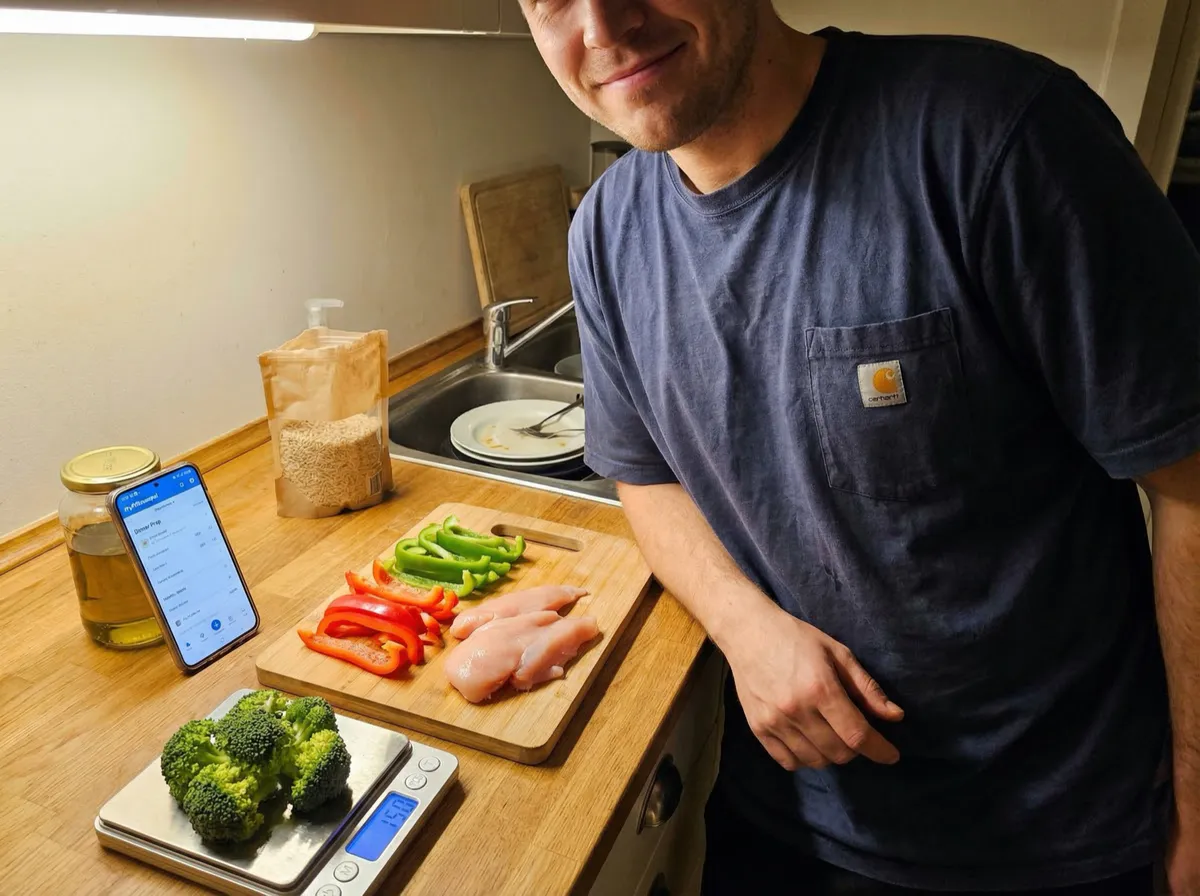
Underestimating portion sizes. Humans are remarkably bad at estimating portions visually. Research from the USDA consistently shows that people underestimate portion sizes by 25–40%, with the error increasing for calorie-dense foods like nuts, oils, and cheese. Using a kitchen scale for the first two weeks helps calibrate your visual estimates for the long term. After that initial calibration period, your eyeball estimates become significantly more accurate.
Tracking selectively. Logging lunch but skipping the three handfuls of pretzels you grabbed from the break room between meetings is a form of self-deception that undermines the entire system. The calories you don’t log are usually the calories that matter most — mindless snacking accounts for an estimated 200–400 “invisible” calories per day for many adults.
Quitting after a high-calorie day. This is the most destructive mistake. You eat a large meal, feel guilty, and stop logging entirely rather than face the data. But a single 3,000-calorie day in the context of a 14,000-calorie week (2,000 per day average) shifts your weekly average by only about 143 calories per day. The data puts it in perspective; the avoidance does not.
Overcomplicating the system. Attempting to track 12 variables on day one — calories, protein, carbs, fat, fiber, sodium, sugar, water, mood, energy, sleep, and steps — is a recipe for abandonment. Start with food and portions. Add one variable per week only if the previous one feels effortless.
Best Food Journal Apps Compared
Choosing the right app removes the biggest source of friction from food journaling. Here’s how the major options stack up for someone starting their first food journal.
Amy Food Journal is built around natural-language input — you type what you ate as a normal sentence, and the AI parses it into calories, protein, carbs, and fat. It also supports barcode scanning and photo-based food recognition. The interface is deliberately minimal, designed to make the logging action as fast as possible (roughly five seconds per entry). Amy Food Journal tracks calories and macronutrients, syncs with Apple Health, and includes streaks and widgets to reinforce the habit. It’s available on iOS at $9.99/month or $99.99/year with a free 3-day trial.
Cronometer is the strongest option for people who want deep micronutrient data. It tracks 84+ nutrients from USDA-verified sources, which makes it popular among people with specific dietary requirements or health conditions. The trade-off is a more complex interface and slower logging speed — each food requires a database search rather than a natural-language sentence.
MyFitnessPal has the largest food database at over 14 million entries, including restaurant items and regional dishes that smaller databases miss. However, the user-submitted nature of that database means accuracy varies, and the app has become increasingly cluttered with social features, premium upsells, and advertising.
Lose It! offers a clean, approachable interface that works well for beginners. It has solid barcode scanning and a reasonable food database. The free tier is more generous than MyFitnessPal’s, though the paid version ($39.99/year) unlocks macro tracking and meal planning.
For our full analysis of each app with screenshots and detailed pros/cons, see the 10 best food journal apps in 2026 and our AI calorie counter app comparison.
| App | Logging Speed | Database | Tracks | Price | Best For |
|---|---|---|---|---|---|
| Amy Food Journal | ~5 sec (natural language) | AI-powered | Calories, protein, carbs, fat | $9.99/mo or $99.99/yr | Speed and simplicity |
| Cronometer | 20–30 sec | USDA-verified | 84+ nutrients | Free tier; Gold $49.99/yr | Micronutrient detail |
| MyFitnessPal | 15–30 sec | 14M+ user-submitted | Calories, macros, some micros | Free tier; Premium $79.99/yr | Huge food database |
| Lose It! | 15–20 sec | Curated + barcode | Calories, macros | Free tier; Premium $39.99/yr | Beginners on a budget |
Frequently Asked Questions
How long should I keep a food journal?
Most nutrition researchers recommend an initial intensive phase of 8-12 weeks, which is enough time to identify your major eating patterns and build lasting awareness. After that, many people shift to periodic tracking — logging for a week every month or two as a calibration check. The 2019 Obesity study found that participants who tracked for at least 12 weeks maintained significantly better eating habits even after they stopped daily logging.
Do I need to weigh my food on a scale?
For the first one to two weeks, a kitchen scale dramatically improves your portion estimation skills. Research from the USDA shows that visual portion estimates are 25-40% inaccurate on average. After two weeks of scale-based calibration, your eyeball estimates become much more reliable, and you can put the scale away for everyday meals.
What if I eat something and can’t find it in my app’s database?
Log the closest equivalent. “Homemade chicken stir-fry” can be logged as “chicken stir fry” in Amy Food Journal’s natural-language input, and the AI will produce a reasonable estimate. Accuracy within 10-15% is sufficient for food journaling purposes — the consistency of logging matters far more than the precision of any single entry. For homemade dishes, our recipe calorie counter can calculate the total from individual ingredients.
Should I track on weekends and holidays?
Yes, especially weekends. A 2003 study in Obesity Research found that weekend calorie intake averaged 115 calories per day higher than weekdays. Tracking only Monday through Friday gives you an incomplete and misleadingly optimistic picture of your actual intake. Holidays are more flexible — some people benefit from tracking through Thanksgiving dinner, while others find it healthier to take a conscious break and resume the next day.
Will food journaling make me obsessive about food?
For most people, food journaling actually reduces food obsession by replacing vague anxiety with concrete data. However, if you have a history of eating disorders or find that tracking triggers restrictive behaviors, consult a healthcare provider before continuing. A 2020 review in the International Journal of Eating Disorders found that self-monitoring was generally safe for individuals without a clinical eating disorder history, but recommended professional guidance for those with prior diagnoses.
How many calories does the average person discover they’re underestimating?
Substantially. A study in the New England Journal of Medicine found that self-reported calorie intake was 47% lower than actual intake among obese participants and 20-30% lower among normal-weight participants. Even trained dietitians underestimate their own intake by about 10%. This “calorie gap” is precisely what food journaling is designed to close.
Can I just take photos of my food instead of logging details?
Photo-only journals are better than nothing, but they’re less effective for building awareness. You don’t process the nutritional content of a meal by looking at a picture the way you do by typing “cheeseburger, large fries, and a Sprite — about 1,400 calories.” That said, apps like Amy Food Journal use photo-based food recognition as an input method — you photograph your meal, the AI identifies the food and estimates portions, and you confirm the result. That combines the ease of photos with the precision of data logging.
What is the difference between a food journal and calorie counting?
A food journal is any systematic record of what you eat — it can include or exclude calorie data. Calorie counting specifically focuses on tracking energy intake in calories. Many people start with a simple food journal (just foods and portions) and graduate to calorie counting once the habit is established and they want to pursue specific weight goals. Amy Food Journal supports both approaches: you can log meals in natural language and optionally view the calorie and macro breakdown. To understand the research behind why both approaches work, see our article on the science of food journaling.
Start Your Food Journal Today
The research consistently shows that people who track what they eat achieve better outcomes than those who don’t — regardless of their specific diet, fitness level, or health goals. The 2008 Kaiser Permanente study, the 2012 meta-analysis, and the 2019 Obesity study all point to the same conclusion: the act of consistent self-monitoring changes behavior in ways that willpower alone cannot.
The best time to start is now, and the best way to start is simple. Download Amy Food Journal, log your next meal in natural language, and commit to seven days of consistent tracking. You don’t need a kitchen scale, a nutrition degree, or a complicated system. You need a tool that makes logging fast enough to actually do, and a willingness to look honestly at your data.
One week from now, you’ll have a clearer picture of your eating patterns than most people develop in years of guessing. That’s the real power of a food journal — not perfection, but awareness.
This article is for informational purposes only and does not constitute medical or nutritional advice. Consult a qualified healthcare provider before making significant changes to your diet, especially if you have a history of eating disorders or other health conditions.
Keep Reading
All articlesGuides
Food Journal vs. Calorie Counter: Which One Do You Need?
Use a food journal for patterns and context, a calorie counter for estimated totals, or a small hybrid when both answers will change a decision.
Guides
Science of Food Journaling: Why Tracking Doubles Weight Loss
Peer-reviewed research shows food journaling doubles weight loss results. Learn the science, psychology, and best methods to start tracking today.
Guides
Best Calorie Trackers for Homemade Meals Without Fake Precision
Compare calorie trackers for homemade meals and choose cooked yield, equal servings, or an honest estimate—without inventing precision.
Guides
How to Make AI Calorie Estimates More Accurate
Give an AI calorie estimator better inputs with measured amounts, visible portion context, labels, recipe details, and factual corrections.