How to Track Macros: A Step-by-Step Guide (2026)
Learn how to track macros step by step. Calculate your protein, carbs, and fat targets, pick the right app, and start hitting your goals.

Amy Food Journal Team

Tracking macros means logging the grams of protein, carbohydrates, and fat you eat each day rather than just counting total calories. To start, calculate your TDEE using the Mifflin-St Jeor equation, set protein at 0.7–1.0 grams per pound of bodyweight, allocate 25–35% of remaining calories to fat, and fill the rest with carbs. A 2020 systematic review in Advances in Nutrition found that higher protein intake during calorie restriction preserved 33% more lean muscle mass than lower-protein diets (n=1,863). The fastest way to track is with a natural language app like Amy Food Journal, where you type “chicken breast 6oz with rice and broccoli” and the AI returns your macro breakdown in seconds. Below is everything you need to calculate your targets, choose the right tracking method, and avoid the mistakes that derail most beginners.
What Are Macros and Why Do They Matter?
Macronutrients are the three categories of nutrients your body needs in large quantities: protein, carbohydrates, and fat. Each one serves a fundamentally different biological purpose, and each carries a different caloric density. Protein and carbohydrates both contain 4 calories per gram, while fat contains 9 calories per gram — more than twice as energy-dense.
Protein is the building block your body uses to repair and grow muscle tissue, produce hormones and enzymes, and support immune function. Unlike carbs and fat, your body has no efficient way to store excess protein, which means consistent daily intake matters more than with the other two macros. When researchers at McMaster University compared high-protein (2.4g/kg) versus low-protein (1.2g/kg) diets during a calorie deficit combined with exercise, the high-protein group gained 1.2 kg of lean mass while the low-protein group gained none — despite both groups being in a deficit.
Carbohydrates are your body’s preferred fuel source, especially during intense or sustained exercise. They’re stored as glycogen in your muscles and liver, providing readily available energy. Your brain alone burns roughly 120 grams of glucose per day. Fat, meanwhile, is essential for hormone production (particularly testosterone and estrogen), absorption of fat-soluble vitamins (A, D, E, and K), and cellular membrane integrity.
The key insight is this: two people can eat the exact same number of calories and get completely different body composition results depending on their macro split. Someone eating 2,000 calories with 180g of protein will retain significantly more muscle during a cut than someone eating 2,000 calories with 80g of protein. Calories determine whether you gain or lose weight. Macros determine whether that change is muscle or fat. If you are still getting comfortable with tracking food intake, our calorie counting for beginners guide covers the fundamentals before you add macros to the picture.
Why Track Macros Instead of Just Calories?
Calorie counting tells you how much you’re eating. Macro tracking tells you what you’re eating — and that distinction matters more than most people realize when it comes to body composition.
Consider two people both eating 2,000 calories per day in a 500-calorie deficit. Person A gets 35% of calories from protein (175g), 40% from carbs, and 25% from fat. Person B gets 15% from protein (75g), 55% from carbs, and 30% from fat. After 12 weeks of the same strength training program, Person A will likely have lost primarily fat while preserving most of their muscle. Person B will have lost a roughly equal mix of fat and muscle, ending up lighter but not necessarily leaner. A 2021 meta-analysis in the British Journal of Sports Medicine confirmed that higher protein intake preserved 38% more lean mass during energy restriction across 34 randomized controlled trials.
The practical advantages go beyond body composition. Protein is the most satiating macronutrient — gram for gram, it suppresses appetite more effectively than carbs or fat. A study published in the American Journal of Clinical Nutrition found that increasing protein from 15% to 30% of total calories led participants to eat 441 fewer calories per day spontaneously, without any conscious restriction. That’s the difference between white-knuckling through a diet and barely noticing you’re in a deficit.
Carbohydrate intake, meanwhile, directly affects training performance. If you’re doing CrossFit, running, cycling, or any high-intensity activity, cutting carbs too aggressively will tank your workouts. Macro tracking lets you maintain the carb intake your training demands while still hitting a calorie target for fat loss. That flexibility — eating what supports your goals rather than avoiding entire food groups — is why macro tracking has become the default approach for evidence-based coaches and athletes. The science behind food journaling shows that consistent self-monitoring is the strongest behavioral predictor of weight management success, regardless of the specific diet followed.
How to Calculate Your Macro Targets
The calculation is straightforward. You need three numbers: your total daily calories (TDEE), your protein target, and your fat minimum. Carbs fill whatever’s left.
Step 1: Find Your TDEE
Your Total Daily Energy Expenditure is the number of calories you burn per day including all activity. The most validated formula for estimating the baseline — your Basal Metabolic Rate — is the Mifflin-St Jeor equation, which research published in the Journal of the American Dietetic Association found to be accurate within 10% for 82% of people.
For men: (10 x weight in kg) + (6.25 x height in cm) - (5 x age) + 5
For women: (10 x weight in kg) + (6.25 x height in cm) - (5 x age) - 161
Multiply the result by your activity factor:
| Activity Level | Description | Multiplier |
|---|---|---|
| Sedentary | Desk job, little exercise | 1.2 |
| Lightly active | Exercise 1–3 days/week | 1.375 |
| Moderately active | Exercise 3–5 days/week | 1.55 |
| Very active | Exercise 6–7 days/week | 1.725 |
| Extremely active | Intense daily training + physical job | 1.9 |
Worked example: A 30-year-old woman, 150 lbs (68 kg), 5’8” (173 cm), who exercises 4 days per week.
BMR = (10 x 68) + (6.25 x 173) - (5 x 30) - 161 = 680 + 1,081 - 150 - 161 = 1,450 calories
TDEE = 1,450 x 1.55 = 2,248 calories per day
If your goal is fat loss, subtract 300-500 calories. For muscle gain, add 250-400. For maintenance, use the number as-is. You can also use our calorie deficit calculator to run these numbers automatically, or check the how many calories should I eat tool for a quick personalized estimate.
Step 2: Set Your Protein Target
Protein is the one macro you should never shortchange. The research consensus, supported by a landmark 2018 meta-analysis in the British Journal of Sports Medicine (49 studies, 1,863 participants), recommends 0.7 to 1.0 grams per pound of bodyweight (1.6–2.2 g/kg) for people engaged in resistance training.
If you’re significantly overweight (BMI over 30), use your goal bodyweight or lean body mass rather than total bodyweight. Otherwise, the per-pound calculation is simple enough.
For our example: 150 lbs x 0.8g = 120g protein per day (480 calories)
Step 3: Set Your Fat Minimum
Fat should make up 25–35% of total calories. Going below 20% for extended periods can impair hormone production — particularly testosterone in men and estrogen in women — and reduce absorption of fat-soluble vitamins.
The lower end (25%) works well if you prefer more carbs for training performance. The higher end (30–35%) tends to work better for people who feel more satiated with fattier foods or who train at lower intensities.
For our example at 30%: 2,248 x 0.30 = 674 calories ÷ 9 cal/g = 75g fat per day
Step 4: Fill the Rest with Carbs
Subtract protein and fat calories from your total, then divide by 4.
2,248 - 480 (protein) - 674 (fat) = 1,094 calories from carbs ÷ 4 = 274g carbs per day
Final targets:
| Macro | Grams | Calories | % of Total |
|---|---|---|---|
| Protein | 120g | 480 | 21% |
| Fat | 75g | 674 | 30% |
| Carbs | 274g | 1,094 | 49% |
| Total | — | 2,248 | 100% |
These are maintenance targets. To lose fat, reduce total calories by 300–500 (usually by cutting carbs). To build muscle, add 250–400 calories (usually by increasing carbs).
Macro Splits by Goal
Different goals call for different macro ratios. These are evidence-based starting points — not rigid rules. Adjust based on how you feel, your training performance, and your results over 2–4 weeks.
| Goal | Protein | Carbs | Fat | Notes |
|---|---|---|---|---|
| Fat loss | 30–35% | 40–45% | 20–25% | Higher protein preserves muscle in a deficit |
| Maintenance | 25–30% | 45–50% | 25–30% | Balanced for long-term sustainability |
| Muscle building | 25–30% | 50–55% | 20–25% | Extra carbs fuel training and recovery |
| Endurance sports | 15–20% | 55–65% | 20–25% | High carbs support glycogen demands |
| Keto / low-carb | 25–30% | 5–10% | 60–70% | Strict carb restriction for ketosis |
The most important variable across all goals is protein. Whether you’re cutting, bulking, or maintaining, keeping protein at 0.7–1.0g per pound of bodyweight produces the best body composition outcomes regardless of how you split the remaining calories between carbs and fat.
How to Actually Track Your Macros Day to Day
Knowing your targets is one thing. Consistently hitting them is another. The method you choose for daily tracking determines whether you stick with it for two days or two years.
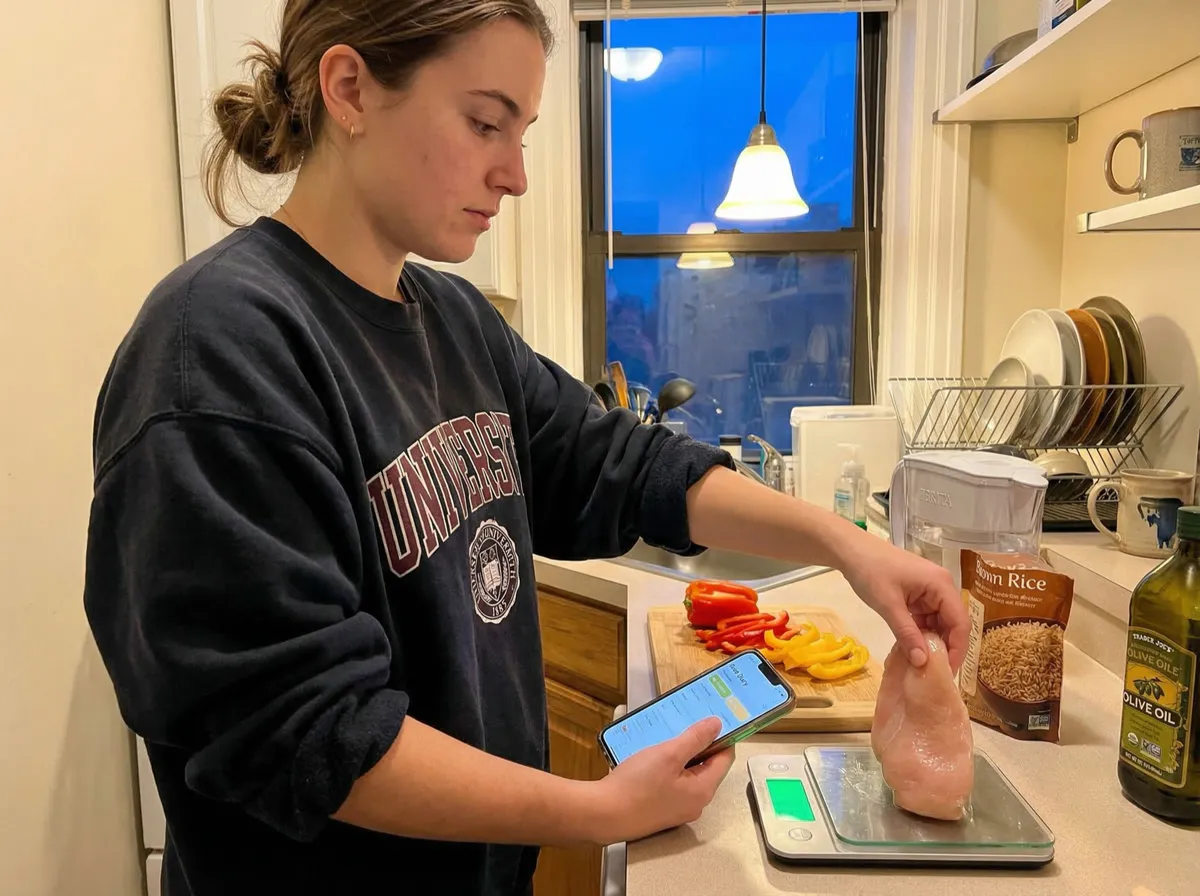
The kitchen scale method
For the first 2–3 weeks, weigh your food with a digital kitchen scale. This sounds tedious, but it’s essential for calibrating your portion sense. Research from the International Journal of Behavioral Nutrition found that people estimate portions with an average error of 25–40%, with calorie-dense foods like nuts, oils, and cheese skewing even higher. A “handful” of almonds might be 15 nuts or 40 — and the calorie difference is 250 calories.
You don’t need to weigh everything forever. After a few weeks, most people develop reliable intuition for their regular meals. But skipping this step means building your tracking on inaccurate foundations.
Choosing a tracking app
The right app makes macro tracking take seconds instead of minutes. The wrong one makes it feel like data entry homework. Here’s how the main options compare:
| App | Logging Speed | Macro Tracking | Database | Pricing |
|---|---|---|---|---|
| Amy Food Journal | ~5 seconds | Calories, protein, carbs, fat | 500K+ foods | $9.99/mo ($99.99/yr) |
| MyFitnessPal | ~45 seconds | Full macros + micros (premium) | 14M+ foods | Free tier / $12.99/mo |
| Cronometer | ~20 seconds | Full macros + 84 micronutrients | 680K+ USDA-verified | Free tier / $5.49/mo |
| MacroFactor | ~25 seconds | Adaptive macro targets | 500K+ foods | $9.99/mo |
Amy Food Journal takes a fundamentally different approach from traditional tracking apps. Instead of searching a database and selecting portion sizes from dropdown menus, you type what you ate in natural language — “grilled chicken 6oz, cup of white rice, steamed broccoli” — and the AI parses it into calories and macros instantly. It works like sending a text message. For people who’ve bounced off traditional calorie counters because the logging process felt too cumbersome, this natural language approach removes the friction that kills consistency.
Cronometer is the better choice if micronutrient tracking matters to you — it tracks 84+ nutrients from USDA-verified data, which is valuable for managing specific health conditions or dietary deficiencies. For a detailed comparison of Amy and Cronometer, see our Amy vs. Cronometer review. MacroFactor stands out for serious athletes because it adjusts your macro targets weekly based on your actual weight trend, essentially acting as an automated nutrition coach. For a broader look at all the options, our best food journal apps roundup covers 10 apps in detail.
The pre-tracking method
One strategy that dramatically improves consistency: log your meals the night before or morning of, rather than after you eat. Plan your day’s food in your app, see that it hits your targets, then eat according to the plan. This eliminates the end-of-day scramble to “make the numbers work” and prevents the common scenario of arriving at dinner with 40g of protein remaining and 200 calories left.

Common Macro Tracking Mistakes
The gap between knowing how to track and tracking effectively usually comes down to a few predictable errors.
The most expensive mistake is forgetting to log cooking fats. A tablespoon of olive oil adds 119 calories and 14g of fat. Two tablespoons of butter in a pan adds 204 calories. When people tell me their macros “should be working” but they’re not losing fat, unreported cooking oil is the culprit roughly half the time. Get in the habit of measuring oil with a tablespoon rather than pouring from the bottle.
The second most common error is portion drift. You weigh your rice carefully during week one, estimate it during week two, and by week four your “cup of rice” is actually 1.5 cups. A study in the Journal of the American Dietetic Association found that even trained dietitians underestimated calories by 200–250 per meal when they stopped measuring. If your progress stalls, go back to the scale for a week before adjusting your targets.
Inconsistency is more damaging than imprecision. Tracking meticulously Monday through Thursday and then going completely off-plan Friday through Sunday means you’re only tracking 57% of the time. Your body doesn’t reset weekly. If you can’t track on weekends, at minimum track protein — it’s the macro that matters most for body composition, and roughly estimating carbs and fat is better than tracking nothing.
Finally, many beginners change too many variables at once. If you’re not seeing results after two weeks, adjust one thing: drop carbs by 25g, or add 200 steps per day, or increase protein by 20g. Give each change two weeks to show its effect before changing something else. Body composition doesn’t respond overnight, and stacking changes makes it impossible to know what’s actually working.
How to Track Macros When Eating Out
Restaurant meals are where most trackers throw in the towel. You can’t weigh your food, ingredients are unknown, and portion sizes are unpredictable. But giving up tracking at restaurants means ignoring what is often the highest-calorie meal of your week.
The practical approach: estimate rather than abandon. Most chain restaurants publish nutrition data online — search “[restaurant name] nutrition” before you go. For non-chain restaurants, find the closest equivalent in your tracking app and adjust for portion size. A restaurant salmon filet is typically 6–8 ounces. Their side of rice is usually 1–1.5 cups. Their vegetables are usually cooked in 1–2 tablespoons of oil or butter.
You don’t need to be exact. If your actual meal was 650 calories and you logged 700 or 600, that’s close enough to maintain the awareness that makes tracking valuable. The alternative — logging nothing — means that meal might as well not exist in your data, and your weekly average becomes unreliable.
With Amy Food Journal, restaurant tracking is particularly fast because you can type a description like “grilled salmon with rice and vegetables, olive oil, restaurant portion” and the AI handles the estimation. No scrolling through database entries trying to find the right match.
Frequently Asked Questions
How close do I need to hit my macro targets each day?
Within 5-10 grams per macro is excellent. Your body responds to weekly averages, not daily precision. If you eat 115g protein one day and 125g the next, both of those hit a 120g target effectively. Obsessing over exact numbers increases burnout without improving results.
Is protein powder necessary for hitting protein targets?
No. You can reach 120-150g of protein daily from whole foods: a chicken breast (43g), two eggs (12g), Greek yogurt (17g), and a serving of lentils (18g) gets you to 90g from just four foods. Protein powder is convenient when whole food isn’t practical — post-workout, traveling, or when you need protein without much volume — but it’s a supplement, not a requirement.
How often should I recalculate my macros?
Every 8-12 weeks, or whenever your weight changes by more than 5-10 pounds. As you lose weight, your TDEE decreases proportionally. A person who started at 200 lbs and is now 180 lbs needs roughly 150-200 fewer daily calories to continue losing at the same rate. Our calorie deficit calculator can help you recalculate when it is time to update.
Are carbs bad for fat loss?
No. A 2022 meta-analysis in the BMJ comparing low-carb and low-fat diets across 121 trials found no significant difference in weight loss at 12 months. Carbs don’t prevent fat loss — excess calories do. Choose whichever carb level lets you stick to your calorie target while maintaining energy for training.
Should I eat the same macros on rest days and training days?
For most people, keeping macros consistent daily is simpler and works well. Advanced athletes sometimes cycle carbs — eating more on training days and less on rest days — but the difference in results is marginal compared to just hitting consistent daily targets. Start with the same targets every day and only complicate things if you plateau.
Can I build muscle and lose fat at the same time?
Yes, particularly if you’re new to resistance training, returning after a long break, or carrying significant body fat. This is called body recomposition. Eat at maintenance calories or a very slight deficit (100-200 calories), keep protein at 1g per pound of bodyweight, and follow a progressive strength program. Experienced lifters with lower body fat percentages typically need dedicated bulk and cut phases because the margin for simultaneous change narrows significantly.
What is the best macro tracking app for beginners?
Amy Food Journal is the fastest option — type what you ate in plain English and the AI parses it into macros. It tracks calories, protein, carbs, and fat at $9.99/month with a free 3-day trial. If you want micronutrient tracking (vitamins, minerals), Cronometer is the better fit. See our full best food journal apps roundup for detailed reviews.
Do I need to track macros forever?
No. Most people track actively for 3-6 months, develop strong intuition for portion sizes and macro-dense foods, then transition to a more relaxed approach — tracking only protein, or tracking only on weekdays, or just tracking when their goals shift. The initial tracking period teaches you a skill that persists even after you stop logging every meal. For a practical framework for building a lasting tracking habit, see our how to start a food journal guide.
How do I track homemade recipes?
Weigh each ingredient before cooking, log them individually, divide by the number of servings, and save it as a custom meal in your app. Once saved, you can log that recipe in one tap going forward. This takes 5 minutes the first time and 5 seconds every time after. Our recipe calorie counter can also calculate the nutritional breakdown from a list of ingredients.
What if I go over my macros one day?
Nothing bad happens. A single day over your targets has zero measurable impact on your body composition. What matters is your average over weeks and months. If you went 500 calories over on Saturday, you could eat 100 fewer calories each day Sunday through Thursday to balance the weekly total — or you could simply move on and resume normal tracking. Both approaches work. The worst thing you can do is let one off day spiral into abandoning tracking entirely.
The Bottom Line
Tracking macros is straightforward once you understand the framework: calculate your TDEE, set protein at 0.7–1.0g per pound, allocate 25–35% of calories to fat, and fill the rest with carbs. The hard part isn’t the math — it’s the consistency of daily logging.
That’s why the tool you use matters. If tracking takes 3 minutes per meal in a traditional database app, you’ll quit within two weeks. If it takes 5 seconds by typing a natural language description into Amy Food Journal, you’ll actually do it long enough to see results. A 2019 study in the journal Obesity found that participants who logged food consistently for at least 14.7 minutes per day lost three times more weight than inconsistent loggers — and the biggest predictor of consistency was how frictionless the logging process felt.
Start with the targets from this guide, track consistently for two weeks, and adjust based on your weight trend and how you feel. The numbers will tell you everything you need to know.
Keep Reading
All articlesGuides
Best Calorie Trackers for Homemade Meals Without Fake Precision
Compare calorie trackers for homemade meals and choose cooked yield, equal servings, or an honest estimate—without inventing precision.
Guides
How to Make AI Calorie Estimates More Accurate
Give an AI calorie estimator better inputs with measured amounts, visible portion context, labels, recipe details, and factual corrections.
Guides
Calorie Tracker Apps That Sync With Apple Health
Compare six calorie trackers by documented Apple Health read and write support, Dietary Energy, macros, history, and duplicate-data risk.
Guides
Does Apple Health Track Calories Eaten?
Apple Health can store calories eaten as Dietary Energy, but it does not identify meals. Learn how to view, add, and trace each value.