Why the Same Food Has Different Calories in Different Apps
The same food can show different calories because of serving weights, raw or cooked entries, rounding, and source data. Learn which number to use.

Chris Raroque
Updated
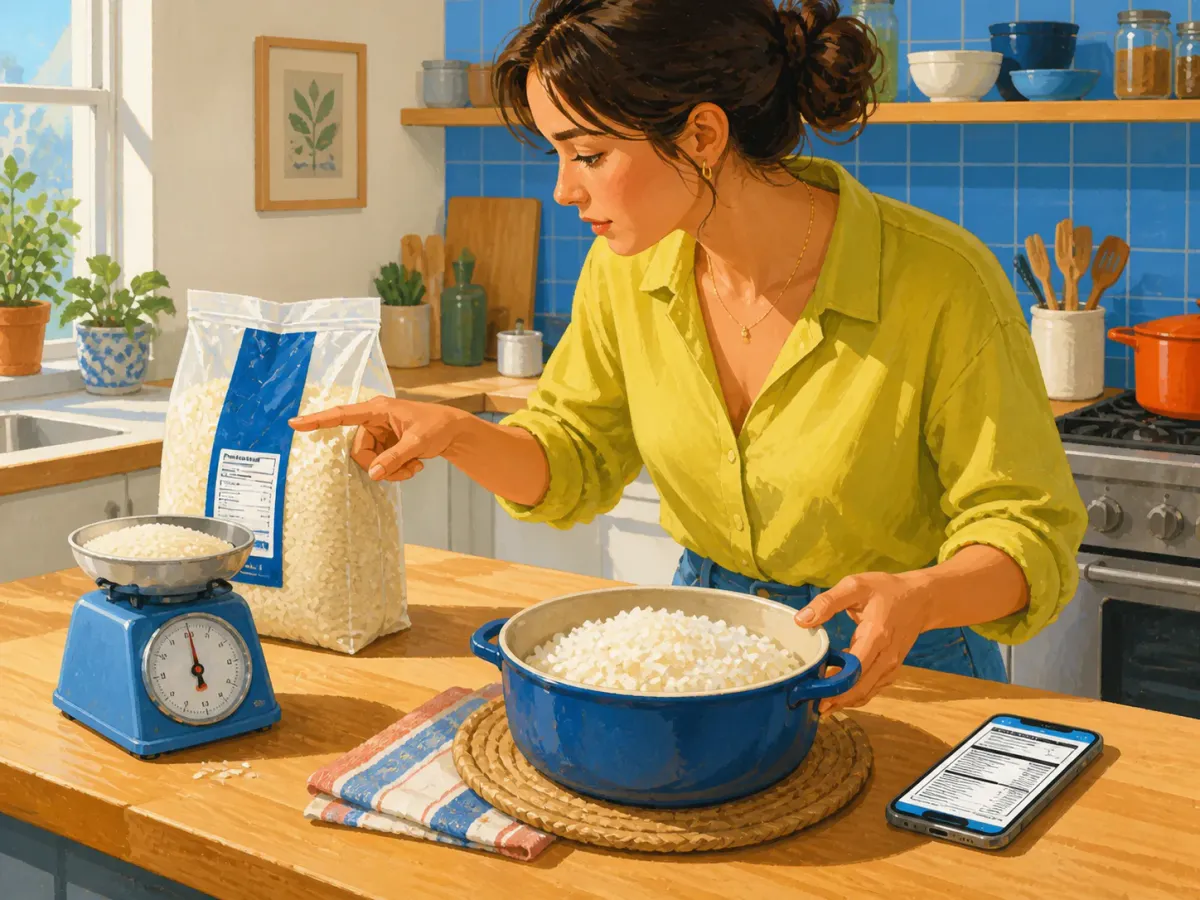
Weigh 150 grams of cooked white rice and search for it in a calorie app. Choose the cooked entry and you get about 195 calories. Choose a raw entry for the same 150 grams and you get about 548.
Same rice. Same scale. The larger result describes the rice before it absorbed water, while the bowl in front of you was weighed after cooking. The app cannot know which state you meant unless the entry, or your description, says so.
That is the first thing to check when two polished answers disagree. The problem is often not which app is wrong, but whether the two entries describe the same food in the same state and amount.
The short answer
Match the exact food. Match the state you weighed it in. Put both entries on the same gram basis. Then use the current source closest to what you actually ate.
Do not choose the lower number, the higher number, or the entry with more decimal places simply because it feels safer or more precise.
For a current packaged food, that is usually the package in your hand. For a basic food, use a documented generic record that matches the variety and preparation. For a restaurant item, use the restaurant’s current official nutrition information for the exact build. For a homemade dish, use its actual ingredients and finished batch weight.
A food database is not one uniform source
USDA FoodData Central itself contains several data types built for different jobs. Its data-type documentation describes:
- Foundation Foods, with analytically derived values and sample-level metadata for minimally processed foods;
- FNDDS, compiled for foods reported in the federal What We Eat in America survey;
- Branded Foods, based on label information supplied by manufacturers and other industry providers; and
- SR Legacy, a historical USDA collection whose final release was April 2018.
An app can combine several public datasets with licensed sources, restaurant data, its own reviewed foods, and user-created entries. A search for “chicken breast” may therefore return a laboratory-informed generic food, a branded raw product, a restaurant item, and somebody’s personal entry. The shared words do not make those records interchangeable.
Cronometer’s current data-source guide, for example, identifies separate lab-informed, label-based, community, and custom sources. MyFitnessPal says its database includes foods it researches and adds as well as foods submitted by members.
Those are descriptions of each company’s process, not proof that every result is current or that one app is always more accurate. The useful question is smaller: where did this entry come from, and does it match this food?
Serving names hide gram differences
“One cup” feels more concrete than it is. An app still needs a rule that maps that cup to a gram weight. That mapping depends on the food, its state, density, packing, and the portion stored in the source record.
FDA says a packaged-food serving size is based on the amount people customarily consume, not a recommended portion. The label presents a household measure followed by its metric amount, such as 1 cup (227 g). When two entries say “one serving,” the gram line is the part you can actually compare. See the FDA’s serving-size explanation.
MyFitnessPal’s current serving-size documentation makes one app-level mechanism visible: the available units are limited to those entered when the food was created, and a member-created entry typically has only one choice. The serving menu is part of the record, not an independent measurement of your food.
Three official USDA examples show why:
- The SR Legacy cooked long-grain white rice record maps one cup to 158 grams.
- The olive-oil record maps one tablespoon to 13.5 grams. At 884 calories per 100 grams, that is 119.34 calories before display rounding.
- The raw-banana record maps one medium banana to 118 grams. USDA Standard Reference data are presented for the edible portion, so that weight is not the banana plus its peel.
An interface could reasonably display the oil calculation as 119 or 120, depending on its rounding rule. That is a trivial display difference. A cup mapped to the wrong number of grams is a different problem and can create a much larger one.
When both entries disclose grams, put them on the same basis: divide the displayed calories by the serving grams, then multiply by 100.
If an entry does not disclose its gram basis, do not invent one. Look for a better-documented entry.
Raw and cooked entries are different bases
Water makes the raw-versus-cooked mistake look like an app failure.
USDA SR Legacy lists regular enriched long-grain white rice at 365 calories per 100 grams raw in FDC ID 168877 and 130 calories per 100 grams cooked in FDC ID 168878. These are two generic database records, not a before-and-after experiment on one pot. Still, they show the scale of the selection error.
For 150 grams of cooked rice, the matching cooked record gives 195 calories. Applying the raw record to that same cooked weight gives about 548 calories.
Cooking did not erase most of the rice’s energy. The cooked portion contains water that was not present in the same mass of dry rice. With meat, water loss can make cooked food more calorie-dense per 100 grams. Added oil, discarded drippings, drained liquid, breading, and sauces can also change the batch.
The rule is simple: match the entry to the state in which you weighed the food. Cronometer gives the same instruction in its current raw-or-cooked logging guide.
Compare the food, state, and grams before you compare app names.
Labels round, and apps may preserve different stages
For U.S. Nutrition Facts labels, calories below 5 may be shown as zero. Values up to and including 50 are expressed to the nearest 5-calorie increment; values above 50 are expressed to the nearest 10. Fat, carbohydrate, and protein have their own display rules too.
That is why multiplying the rounded macro numbers on a label does not always reproduce the printed calorie number. The underlying nutrient amounts can contain more precision than the displayed grams, and the calorie total is rounded after it is calculated.
Suppose the unrounded calculation for one serving is 103 calories. The label can display 100. An app that copies the printed label will show 250 calories for 2.5 servings; a system that retains the unrounded value will reach about 258 before display rounding.
Small differences near the allowed increments do not prove either entry describes a different food. But label rounding cannot explain a different serving weight, a 150- versus 250-calorie gap, or a missing ingredient.
For more on why visible macro arithmetic can diverge from a calorie total, see how to track macros.
Small differences can begin in the calculation
Once the food, state, and grams match, a small gap may come from the calculation method itself. The familiar shortcut assigns 4 calories per gram of protein and carbohydrate and 9 per gram of fat. That general Atwater method is useful, but it is not the only method allowed under FDA regulation 21 CFR 101.9.
USDA’s own April 2026 Foundation Foods download makes the point. Its raw, unenriched long-grain white rice record, FDC ID 2512381, contains two calculated energy values: about 359 and 370 calories per 100 grams. One uses general factors and the other uses food-specific factors.
That 11-calorie difference is real, but it is not worth chasing at lunch. It is the kind of remaining gap you can stop investigating after the food, state, grams, and source all match.
Current labels can outrank old database entries
Branded data has a shelf life. A manufacturer can change a recipe, package size, or serving definition while an old app entry remains in recent searches or a saved-food list.
USDA explains that its Branded Foods data comes from food-industry providers and is standardized for FoodData Central. It also warns that values converted to 100 grams can carry label-rounding variability, especially for small servings. Product histories can show changes to descriptions, brand information, nutrient values, and ingredients.
For the package in your hand:
- Match the brand and complete product name.
- Match the serving grams, not only the serving words.
- Compare calories and one other field, such as protein or fat.
- Check the entry’s source or update date when available.
- If the app and current package disagree, use the current package and save a private corrected entry.
A barcode is a lookup key, not a laboratory test. MyFitnessPal’s help documentation even provides a workflow for cases where a barcode returns the wrong food.
User-created entries deserve the same inspection, not automatic rejection. A careful user may copy a label perfectly. Another entry may have a typo, an old package, or a serving that only makes sense to its creator. MyFitnessPal notes that editing a database item effectively creates a new food and that a previously saved frequent item can retain the old version. Its current check-mark documentation also says reviewed entries can still contain mistakes.
A badge tells you something about a review process. It does not tell you that the record matches today’s package on your counter.
Restaurant numbers have their own rules
For a current named restaurant item, start with the restaurant’s official nutrition page or configurator, then match the size and build.
Under 21 CFR 101.11, covered U.S. chains declare calories for standard items as usually prepared and offered. Menu calories use the same nearest-5 increments through 50 and nearest-10 increments above 50. The business must have a reasonable basis for the value and take reasonable steps to follow the recipe and portion behind it.
FDA’s supplemental guidance says natural variation can be considered in that reasonable basis and that laboratory analysis is not required. A menu number can therefore be properly supported without being a chemical measurement of the plate you received.
There is no blanket rule saying every restaurant plate may be 20% above the menu. The familiar 120% compliance criterion appears in FDA guidance for laboratory composites of packaged foods; it is not a per-serving restaurant allowance. If an app differs from a current official menu, first check whether the app has an old item, another size, or the standard build while you ordered modifications.
Which calorie number should you use?
Use the source closest to the food you actually ate, then keep that choice consistent.
| What you ate | Best practical starting point | What to verify |
|---|---|---|
| Current packaged food | Current Nutrition Facts label | Exact product, serving grams, servings eaten |
| Basic food such as rice, fruit, meat, or oil | Documented generic database entry | Variety, raw/cooked/drained state, edible portion |
| Current chain-restaurant item | Restaurant’s official nutrition page or builder | Size, standard build, additions and removals |
| Homemade recipe | Actual ingredient labels or documented records plus finished batch weight | Every ingredient, oil, edible yield, portion weight |
| Food with no close documented match | Transparent estimate or range | Assumptions that could materially change the answer |
For a homemade batch, actual ingredient totals and cooked-yield arithmetic give you a better foundation than a generic “homemade lasagna” entry. If you are new to the whole process, the calorie-counting guide explains how to build a useful record without turning every meal into a research project.
Here is the one-minute check:
Same food? Same state? Same grams? Closest current source?
If the first three answers are not yes, the calorie values are not comparable yet.
Do not average two mismatched entries. Do not choose the higher number as punishment or the lower one as a reward. If you correct a recurring food, leave yourself a plain note such as current package, 42 g or weighed cooked. That note will be more useful next week than an unexplained decimal.
When to stop investigating
Resolve a discrepancy when the food is calorie-dense, you eat it often, or the difference would change a real decision. Oil, nut butter, a daily cereal, a saved recipe, and a repeat restaurant order deserve more attention than a one-time garnish.
Stop when both entries describe the same amount and state, the remaining gap is consistent with rounding or a documented calculation choice, and better evidence is unavailable. There is no universal acceptable percentage for every food. A 20-calorie difference means something different in a teaspoon of oil than in a large mixed meal, and frequency matters.
Consistency is not a substitute for accuracy, but it is what lets an imperfect log remain useful. Repeatedly switching sources because another result looks more precise can add more noise than keeping one well-matched record.
Amy Food Journal, which I created, starts each new entry with a fresh web search across current nutrition databases, restaurant pages, and brand information, then keeps its sources visible. That can make an old package or the wrong preparation state easier to catch, but it cannot repair a vague description: “150 grams of cooked long-grain rice” gives Amy, or any tracker, better evidence than “a bowl of rice.”
Frequently asked questions
Why does MyFitnessPal show different calories than Cronometer?
The selected entries may come from different source records, serving conversions, food states, brands, or contributors. Open the entry details and compare the exact description and grams before comparing the calorie total. For broader product context, see the MyFitnessPal review and Cronometer review.
Which calorie app is the most accurate?
No app has the best entry for every food. Accuracy depends on the record you select and how closely it matches what you ate. A current package label is usually strongest for that packaged product; a documented generic record is usually more useful for a basic food.
Should I trust the barcode result or the package?
Use the current package when the two disagree. A barcode can point to an old version, another package size, or an incorrect association. Match the serving grams and at least one second nutrient before saving the result.
Should I log rice, pasta, or meat raw or cooked?
Use the entry that matches the state in which you weighed it. Dry rice goes with a dry or raw entry; cooked rice goes with a cooked entry. For meat, check the full description because cooking method, skin, fat, and retained moisture can all matter.
Why do calories not equal protein times 4, carbs times 4, and fat times 9?
The displayed macros may be rounded, some foods use specific Atwater factors, and fiber or sugar alcohols can receive different treatment. The 4/4/9 calculation is a useful check, not a guaranteed reconstruction of the label’s unrounded calculation.
Is a verified food entry always correct?
No. “Verified” or a check mark describes an app’s review process. It does not guarantee that the entry matches the current product, serving, preparation state, or package in front of you.
Should I use the higher calorie number to be safe?
Not automatically. Choosing the higher result creates a one-way bias without resolving the mismatch. Choose the closest source, and use a range only when the remaining uncertainty could change a decision.
The number should describe the food, not win the search
Two calorie values can differ without either app being universally broken. The fastest way through the disagreement is to stop comparing headlines and inspect the record underneath them.
Match the food. Match its state. Match the grams. Choose the closest current source. Then move on with a number you can explain and use again.
Keep Reading
All articlesGuides
Best Calorie Trackers for Homemade Meals Without Fake Precision
Compare calorie trackers for homemade meals and choose cooked yield, equal servings, or an honest estimate—without inventing precision.
Guides
Does Apple Health Track Calories Eaten?
Apple Health can store calories eaten as Dietary Energy, but it does not identify meals. Learn how to view, add, and trace each value.
Guides
How to Count Calories at Restaurants Without Nutrition Information
Estimate restaurant calories without nutrition facts by matching components, using official or USDA anchors, and keeping an honest working range.
Guides
Food Journal vs. Calorie Counter: Which One Do You Need?
Use a food journal for patterns and context, a calorie counter for estimated totals, or a small hybrid when both answers will change a decision.