Recipe Calorie Calculator: Calories Per Portion by Weight
Add a recipe's ingredient calories, enter its cooked batch weight, and calculate calories per 100 grams or any uneven homemade portion.

Chris Raroque
Updated
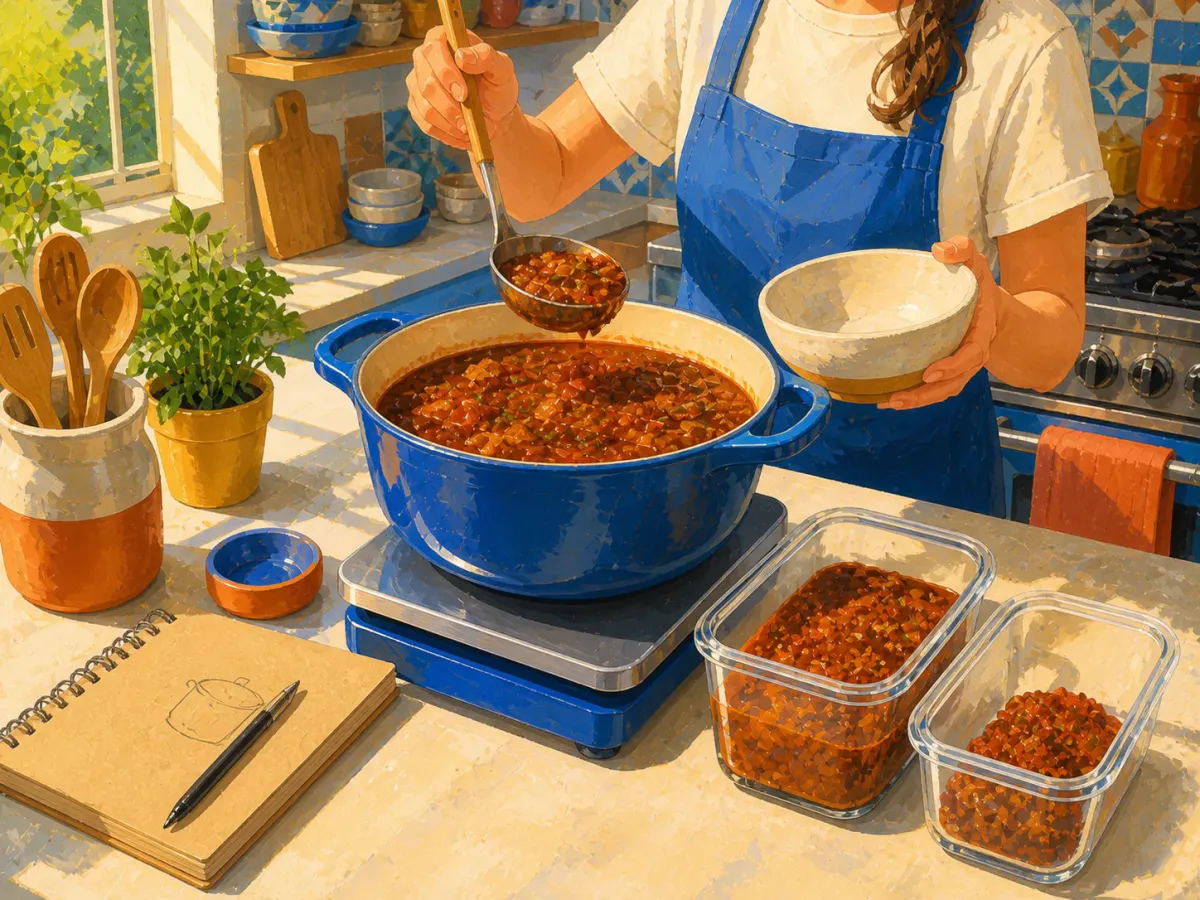
The chili is finished, the first bowl is gone, and the recipe still says six servings. But your bowl was deep, tomorrow's container is shallow, and the food left in the pot does not look like five identical portions.
Dividing a recipe by six only works when six equal servings actually exist. For an ordinary homemade batch, the more useful question is how many calories are in this weighed portion of the food you cooked.
Add the calories that went into the edible batch, weigh the finished batch, and use its calories per gram for any portion you serve.
Keep the finished batch weight and portion weight in the same unit. Grams are easiest.
For example, a 2,400-calorie batch that finishes at 1,920 grams contains 1.25 calories per gram. A 315-gram portion displays as 394 calories.
The result is still an estimate because ingredient records, label rounding, oil left in the pan, discarded liquid, and measurement error all affect the inputs.
Cooked yield method
Recipe calorie calculator
Add the calories in each ingredient, then use the finished edible batch weight to estimate any weighed portion. Protein is optional.
Recipe result
Batch and portion
Finished edible batch: g
- Total ingredient Calories
- Total ingredient protein
- g
- Estimated Calories per gram
- Estimated Calories per 100 g
- Estimated Calories in portion
- Estimated protein in portion
- g
- Portion of finished batch
Protein uses only rows where protein was entered; rows left blank are excluded from the protein estimate.
Estimate based on the ingredient Calories and weights entered.
First, find each ingredient’s calories
Start with the package label for the exact branded food in your kitchen. For a basic food without a label, use a food-composition record that matches what you weighed.
If a label lists 150 calories for 40 grams and you used 65 grams, divide 150 by 40 and multiply by 65. The ingredient contributes 243.75 calories before display rounding.
If a database lists a food per 100 grams, divide that calorie value by 100 and multiply by the grams used.
USDA FoodData Central contains several kinds of records. Foundation Foods are analytically derived basic-food records, Branded Foods come from manufacturer label data, and FNDDS records are used for foods reported in the federal dietary survey. Those sources are useful for different jobs, so the first search result is not automatically the best match.
Food state matters too. FoodData Central’s Foundation Foods documentation says food descriptions can distinguish raw from cooked, enriched from unenriched, and edible material from refuse. If you weigh 200 grams of dry pasta, use a dry-pasta record for that ingredient. Do not apply a cooked-pasta value to the dry weight and then adjust again for water gain.
The ingredient list is where most avoidable errors begin. Include oil, butter, dressing, coconut milk, cheese, glaze, sugar, and toppings mixed into the batch. Water and salt may contribute zero calories, but listing them can still make the recipe easier to rebuild.
Second, weigh the finished edible batch
The finished batch is the food available to be served, without the pot.
The cleanest method is to place the empty pot or storage container on the scale, tare it to zero, and add the finished food. If the recipe must stay in its cooking pot, weigh that pot while empty before you begin. After cooking, subtract the empty-pot weight from the weight of the pot and finished food.
Use the weight after you have handled anything that will not be eaten. Drain the liquid first if it will be discarded. Remove bones if the final portions will not contain them. If half a sauce stays in a separate pan, the denominator should not pretend it reached the serving bowl.
The numerator and denominator have to describe the same food. That sentence is more useful than any universal “add 15% for cooking” rule.
Third, weigh the portion you actually served
Put the empty bowl or container on the scale and tare it. Add the portion and enter its gram weight.
This is the step that makes the method work for real leftovers. The batch may have been intended for six meals, but you do not have to force each meal to equal one sixth. The portion weight tells you what fraction of the finished food is in front of you.
If the bowl cannot sit on the scale, weigh an empty matching container, weigh it again with the food, and subtract. Do not include a lid, spoon, or plate in one measurement but not the other.
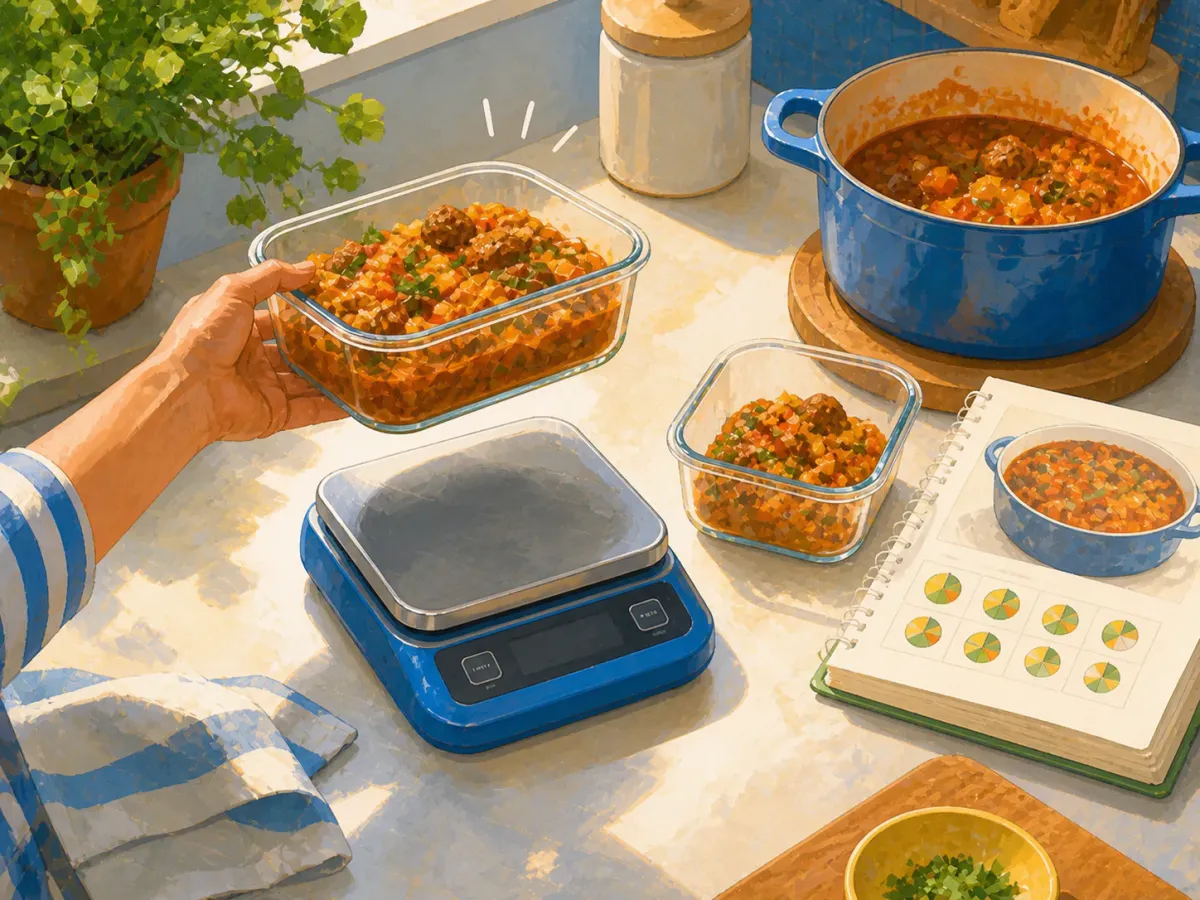
A chili example
Imagine that the completed ingredient rows add up to 2,400 calories. The empty pot has already been tared, and the finished edible chili weighs 1,920 grams.
The batch contains 1.25 calories per gram: 2,400 divided by 1,920. That is 125 calories per 100 grams.
Now weigh two unequal portions:
| Portion | Weight | Share of the batch | Estimated calories |
|---|---|---|---|
| A | 315 g | about 16.4% | 394 |
| B | 250 g | about 13% | 313 |
Neither portion has to be called “one serving” in advance. The scale connects each bowl to the same batch total.
The calculator should keep the unrounded values for its math and round only what it displays. Rounding 1.25 first happens to work here, but early rounding can drift in other recipes.
Why cooked yield belongs in the denominator
Cooking can make food lighter when moisture evaporates. It can make food heavier when rice, pasta, or beans absorb water. Fat can leave meat, oil can enter fried food, and liquid can be poured away.
USDA’s recipe-calculation description uses ingredient weights, nutrient data, cooking yields, and retention factors to account for those changes in professional food-composition work. USDA’s meat and poultry yield report also describes weight changes from moisture loss, water absorption, and fat gain or loss. The report is specific to its foods and methods, not a multiplier for every dinner.
At home, weighing the finished edible batch captures the yield of this cooking session. Suppose two pots each contain 1,800 calories. One finishes at 1,800 grams and the other simmers down to 1,500 grams:
| Finished yield | Calories per 100 g |
|---|---|
| 1,800 g | 100 |
| 1,500 g | 120 |
Evaporation did not add 300 calories to the second pot. It changed how concentrated the same counted energy is in 100 grams of finished food.
When the simple formula needs judgment
The formula works best when the ingredient total and finished weight describe a well-mixed edible batch. A few situations need an explicit decision.
Oil and rendered fat
If all the cooking oil ends up in a sauce that will be eaten, count all of it. If a visible amount remains in the pan, counting every drop probably overstates the finished batch. If fat drains from meat and is discarded, treating the raw-food total as fully retained can do the same.
There is no honest universal absorption percentage. Measure leftover oil or drippings when it is practical and the difference matters. Otherwise record the assumption instead of hiding it behind a precise-looking adjustment.
Drained liquid, marinades, and unused sauce
Count what reaches the edible recipe. If beans are drained, match the entry and weight to drained beans. If a marinade is mostly discarded, do not automatically assign the whole marinade to the meal. If only two thirds of a separate sauce is used, calculate the used share rather than entering the entire saucepan.
Bones, peels, and other refuse
FoodData Central’s Foundation Foods documentation says its portion weights are for edible material without refuse, and its descriptions may identify bones, skin, seeds, or other inedible material. Match that basis. A bone-in raw weight and a boneless calorie record do not describe the same amount of food.
Food left in the equipment
Some batter remains in the mixing bowl. Some soup stays in the blender. Some cheese sticks to the pan. Usually the difference is not worth chasing. For a calorie-dense mixture or a repeat recipe, weighing the actual finished transfer can be more useful than assuming every gram made it.
A batch that is not evenly mixed
Calories per gram assumes the portion resembles the batch. Stir a soup before serving. Recognize that a corner of casserole with more cheese or a bowl with more meat may differ from the average even when its weight is perfect. The calculator can solve portion size; it cannot see ingredient distribution.
Why a label and an app may disagree
A package label, a generic database record, and a tracking app can all show different numbers without any one of them making an arithmetic error.
The FDA’s serving-size guidance says a Nutrition Facts serving size reflects how much people typically consume, not how much they should consume. The gram amount beside that household measure is the useful bridge to a weighed ingredient. If the label says 120 calories per 30 grams and you use 45 grams, calculate from 45 grams rather than calling it one serving.
Labels are also rounded. Under 21 CFR 101.9(c)(1), values up to 50 calories are expressed in 5-Calorie increments, values above 50 in 10-Calorie increments, and amounts below 5 may be shown as zero. Adding many rounded label values can therefore differ from a database that retains more digits.
FoodData Central says Branded Foods come from manufacturer label information and are updated monthly. A saved branded record can change, while the package in your kitchen remains the evidence for the product you actually used.
For the full source-selection problem, see why the same food has different calories in different apps.
When a rough answer is enough
Do not turn an ordinary dinner into a laboratory project.
Spend attention where it can change the result: oil, butter, cheese, nuts, sauces, fatty meat, large portions, and ingredients whose brands differ substantially. Water, herbs, and a few grams of low-calorie vegetables rarely deserve the same effort.
For a one-time meal, a careful ingredient total and finished batch weight may be enough. For a recipe you make every week, save the sources, ingredient states, finished yield, and calories per 100 grams. Recalculate when a brand, amount, or cooking method changes enough to matter.
Without a scale, you can divide the food into genuinely equal containers and divide total calories by the number of containers. That is less helpful for uneven portions, but it is still better than pretending a ladle always holds the same amount. This guide to tracking without weighing food covers the lower-effort options.
Save the useful number
The reusable number is usually calories per 100 grams, accompanied by the recipe version and date. Next time, compare the ingredients and finished yield before assuming the old number still fits.
Amy Food Journal, which I created, can save the finished meal in ordinary language once you have the useful number: “315 g of this chili, 394 calories.” The calculator and method do not require Amy; a note, spreadsheet, or another food journal works too. For a broader routine, read how to start a food journal or calorie counting for beginners.
Frequently asked questions
Do I weigh a homemade recipe before or after cooking?
Use the finished edible weight after cooking as the denominator for portions served from the finished dish. For each ingredient, use a calorie record that matches the state in which that ingredient was measured.
Does cooking change the total calories in a recipe?
Water loss or gain changes weight and calories per gram, not the ingredient calories you already counted. The edible total can change when oil is absorbed, fat or liquid is discarded, or part of an ingredient never reaches the finished dish.
Should I count all the cooking oil?
Count all of it when it remains in food that will be eaten. If a meaningful amount stays in the pan or is discarded, measure or estimate that leftover amount and record the assumption. Do not apply one absorption percentage to every cooking method.
What if my portion weighs more than the finished batch?
Recheck the tare and both entries. The portion may include the bowl, or the finished batch may have been entered without all of the food. The calculator should warn about this mismatch rather than silently treating it as ordinary.
Can I use cups instead of grams?
You can use a label’s household measure to find an ingredient’s calories, but finished-batch and portion math is more repeatable when both are weighed in the same unit. Cups are especially ambiguous for chopped, packed, or compressible foods.
How do I calculate equal servings?
If the finished batch is divided evenly, divide total batch calories by the number of equal portions. If the portions are already plated and differ in weight, calculate each from its own grams instead.
Is this the same as calculating how many calories I should eat?
No. This calculator estimates the energy in a recipe portion. Choosing a daily target is a separate question; use the daily calorie calculator for that purpose.
The useful denominator
A recipe name does not tell you how much is in tonight’s bowl, and a serving count does not make unequal portions equal. The finished edible batch weight does.
Count what went into the food, weigh what came out of the cooking process, and weigh the portion you actually served. That is enough structure to make homemade recipe math useful without pretending dinner was measured in a laboratory.
Keep Reading
All articlesTools
Taco Bell Calorie Calculator: Full Menu Guide
Taco Bell calories for tacos, burritos, bowls, sides, sauces, drinks, and lower-calorie orders. Build a Taco Bell meal that fits your day.
Tools
Calorie Deficit Calculator: Free TDEE Tool
Calculate your calorie deficit for weight loss. Find your BMR, TDEE, and daily target with the Mifflin-St Jeor formula and safe deficit ranges.
Tools
Chipotle Calorie Calculator: Full Menu Guide
Chipotle calories for every item: bowls, burritos, tacos, proteins, and toppings. Build a Chipotle meal under 500 calories with our guide.
Tools
Chick-fil-A Calorie Counter: Full Menu (2026)
Chick-fil-A calories for every menu item. Sandwiches, nuggets, fries, sauces, and breakfast ranked with the best low-calorie meal combos.