Five Food Journal Examples That Each Do a Different Job
See completed food journal examples for awareness, meal planning, protein, symptom discussions, and reflective journaling without numbers.

Chris Raroque
Updated
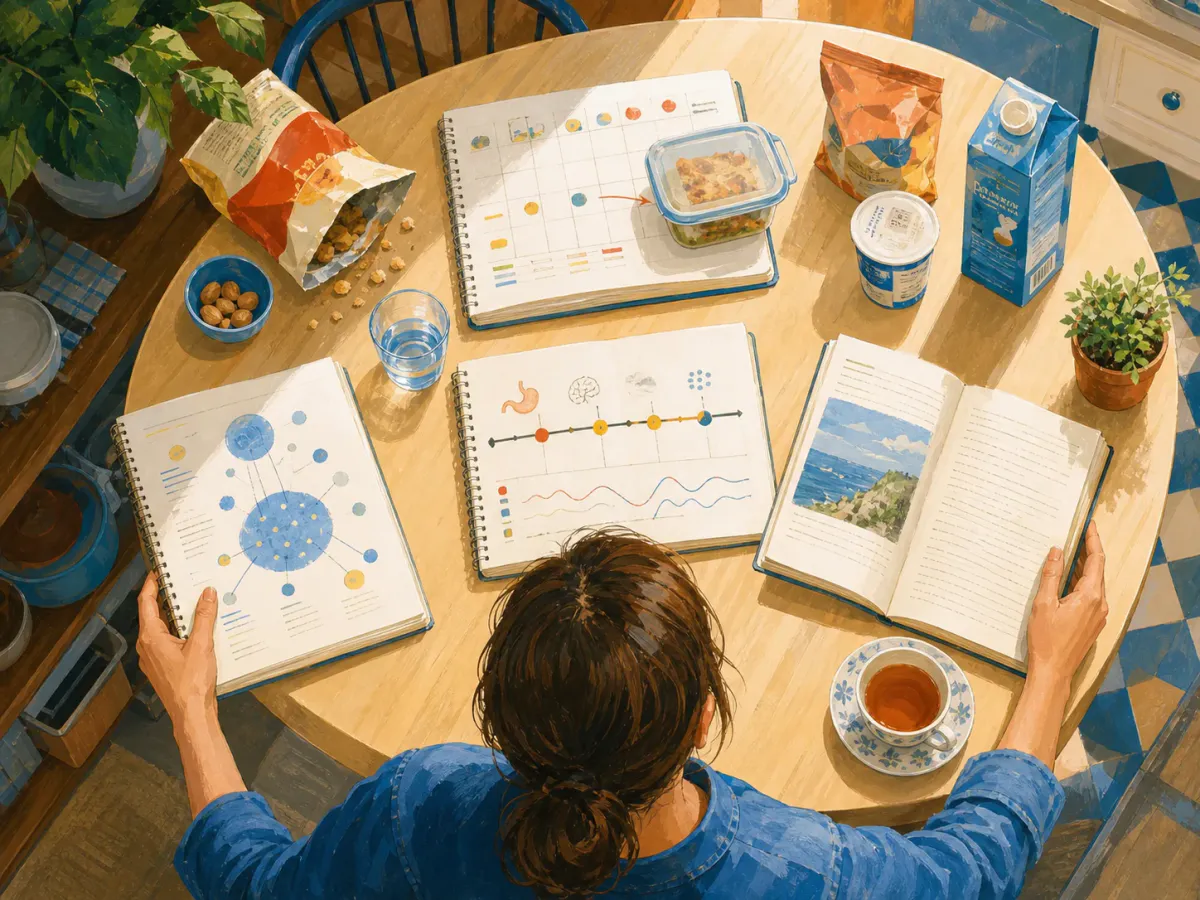
The snack happened between two calls. By dinner, the wrapper is still in your bag, but the time is fuzzy. A useful food journal leaves room for “about four” without inventing 4:03 p.m. or grading the snack.
The right example depends on the job. Awareness needs sequence and context; planning needs what changed and what carries forward; protein needs amounts and sources; symptoms need a timeline, not a diagnosis; reflection can work without food numbers.
The people and days below are fictional. Copy the structure, not the meals. The protein values come from the linked product pages, checked August 21, 2026.
The short answer
| Your question | Copy this example | Keep these fields |
|---|---|---|
| What did my day actually look like? | Awareness | Occasion, food and drink, recorded time, context |
| Where does my plan meet real life? | Meal planning | Plan, what happened, carry-forward note |
| Where is my documented protein coming from? | Protein | Exact item, amount eaten, protein, source |
| What timeline should I bring to a clinician? | Symptoms | Food and drink, onset, duration, description, context |
| Can I reflect without food numbers? | No-number | Occasion, ordinary-language entry, experience |
One vague lunch, rewritten five ways
Suppose the original note says:
Lunch: sandwich, chips, drink.
There is no universally improved version. Each job asks for a different clarification.
For awareness
12:50 p.m. - Turkey sandwich, a small bag of chips, and sparkling water. Lunch was later than expected after a meeting.
For meal planning
Planned leftover curry. A coworker invited me out, so I bought a turkey sandwich, chips, and sparkling water. Curry moves to tomorrow; no new lunch needed.
For protein
Turkey sandwich, chips, and sparkling water. Amounts and exact products not recorded, so protein was not calculated.
For a symptom conversation
12:50 p.m. - Turkey sandwich with cheese, lettuce, mustard, and wheat bread; chips; sparkling water. No symptom recorded at lunch. Mild bloating began at 3:10 p.m. and eased by 4 p.m.
Without numbers
Midday - Turkey sandwich, chips, and sparkling water. Ate outside with a coworker. The break felt welcome after a crowded morning.
The awareness version needs time and context. The planning version needs the displaced food. The protein version needs a defensible refusal to calculate. The symptom version needs chronology. The no-number version needs only the experience the writer wanted to remember.
For blank versions, use the food journal templates.
You can also download all five completed examples as a printable PDF. It contains the same examples in a print-friendly layout.
The National Cancer Institute’s food-record profile describes near-time records that may capture food, amounts, timing, place, and context. It also notes burden, day-to-day variation, and reactivity. That is why these examples do not combine every field.

Example 1: A Food Journal for Awareness
Job: Reconstruct an ordinary day and preserve the gaps honestly.
| Eating time | Food and drink | Recorded | Context |
|---|---|---|---|
| 8:05 a.m. | Oatmeal with banana; coffee with milk | 8:12 a.m. | Ate at the desk while opening email |
| 12:55 p.m. | Leftover pasta; side salad; water | 1:03 p.m. | Lunch started late after a call ran over |
| About 4 p.m. | Pretzels from a small bag | 7:28 p.m. | Added later from the wrapper; exact time not remembered |
| 7:35 p.m. | Two chicken tacos; beans; water | 7:44 p.m. | Ate at the table with a roommate |
What the record shows: Lunch ran late, the snack was easy to forget, and meals happened in different settings.
What it does not show: Calories, nutrients, why the snack happened, or whether this day is typical. “About 4 p.m.” is useful; fake precision is not.
Example 2: A Food Journal for Meal Planning
Job: Treat the plan as working material rather than a compliance test.
| Occasion | Monday’s plan | What happened | Carry forward |
|---|---|---|---|
| Breakfast | Overnight oats and berries | Ate as planned; used the last clean jar | Wash two jars before Wednesday |
| Lunch | Leftover lentil curry and rice | Team lunch was added; leftovers stayed refrigerated | Move curry to Tuesday lunch |
| Afternoon | Apple and peanut butter | Apple was packed; peanut butter was left at home | Put a shelf-stable packet in the work bag |
| Dinner | Sheet-pan chicken, peppers, and potatoes | Meeting ended late; made freezer dumplings and sliced cucumber | Move sheet-pan dinner to Wednesday; vegetables are already on hand |
End-of-day review: Tuesday lunch is covered. Wednesday needs enough cooking time for the sheet-pan meal. One missing item, not the whole plan, caused the snack change.
USDA MyPlate’s weekly planning guidance covers available food, schedules, leftovers, and grocery lists. The journal applies those logistics without calling the team lunch a failure.
This version shows where food, time, and equipment need another pass. It does not show whether the meals were nutritionally complete or whether the same plan would fit another household. Its useful unit is the handoff: refrigerate, move, restock, or shorten.
Example 3: A Food Journal for Protein
Job: Create an auditable protein subtotal without inventing a target or filling unknowns.
The day is fictional. The brands are teaching sources, not endorsements or sponsors.
| Time | Recorded food and amount | Protein recorded | Source note |
|---|---|---|---|
| 8:10 a.m. | One 150 g Oikos Triple Zero vanilla cup; berries | 15 g | Official cup label; berries not calculated |
| 12:35 p.m. | One 74 g StarKist light tuna pouch in a sandwich | 17 g | Official pouch label; bread and toppings not calculated |
| 4:05 p.m. | One 43 g Sargento Pepper Jack, Colby-Jack, and crackers tray | 7 g | Official tray label |
| 7:20 p.m. | 140 g Tasty Bite Organic Madras Lentils; rice; cucumber | 6 g | Official entree label; rice and cucumber not calculated |
| Documented subtotal | 45 g | Not a complete daily total or a recommended target |
This answers, “How much protein can I trace to exact items?” It does not answer personal need or turn missing bread, topping, rice, and cucumber values into zeros.
A label serving is a calculation unit, not a direction. The FDA says it reflects an amount customarily consumed, not a recommendation. Record the amount eaten and recheck changed products. For broader mechanics, see how to track macros.
Example 4: A Food and Symptom Journal for a Clinician Discussion
Job: Preserve chronology and context for a qualified clinician without assigning a cause.
This is a fictional timeline, not a patient history or diagnostic example.
| Time | Food, drink, symptom, or context | Detail |
|---|---|---|
| 7:50 a.m. | Breakfast | Scrambled eggs, toast with butter, coffee |
| 12:35 p.m. | Lunch | Tomato soup, grilled-cheese sandwich, sparkling water |
| 3:10 p.m. | Snack | Packaged granola bar; exact flavor recorded from wrapper |
| 6:45 p.m. | Dinner | Chickpea pasta, jarred tomato sauce, side salad, water |
| 8:05 p.m. | Symptom began | Mild bloating; no other symptom recorded |
| 8:50 p.m. | Update | Bloating had eased |
| 9:20 p.m. | Update | No longer noticed |
| End of day | Other context | About six hours of sleep the night before; unusually rushed commute |
The output is a timeline. Dinner preceded the symptom, but so did every earlier event. Nothing here proves a cause.
The NHS says a clinician may request a food and symptoms diary and warns against unvalidated home tests and cutting foods out without GP or dietitian advice. Bring the record to a conversation; do not use it to diagnose or run an elimination diet.
Example 5: A Food Journal Without Numbers
Job: Preserve the experience of eating without calories, grams, portions, times, targets, or rating scales.
| Occasion | Entry |
|---|---|
| Morning | Toast with jam and milky tea. Wanted something quick and warm. Ate by the window before work. |
| Midday | Bean and cheese quesadilla with salsa. Arrived hungry after back-to-back calls. The meal felt rushed, but it tasted good. |
| Afternoon | A piece of chocolate from the break room. Enjoyed it and went back to the project. |
| Evening | Mushroom noodle soup with a friend. Dinner felt unhurried and comfortable. |
| Reflection | The rushed part of the day was the run of calls, not a particular food. Dinner had more space around it. |
This is not a calorie journal with hidden numbers. It records setting, appetite, pace, and experience without exercise compensation, “clean” eating, or a score.
Words still need restraint. “Lunch felt rushed” describes an experience. “I was bad at lunch” turns food into a character judgment. “Comfortable after dinner” preserves a feeling; it does not require the writer to explain or optimize it.
What the Five Examples Actually Reveal
The same field can be essential in one journal and clutter in another. Read only as far as the entry allows:
| Example | Directly visible | A reasonable next question | Not supported |
|---|---|---|---|
| Awareness | Lunch was late and the snack was entered later | Does this happen on other call-heavy days? | The reason for snacking |
| Meal planning | Monday dinner changed and ingredients carried forward | Which evenings need a shorter option? | Whether the replacement meal was better or worse |
| Protein | Four exact labels support a 45 g subtotal | Are the uncounted items relevant to this person’s purpose? | Total daily intake or a personal target |
| Symptoms | Mild bloating began after dinner and later resolved | Has a similar sequence happened on other documented days? | A trigger, intolerance, or diagnosis |
| No-number | Midday felt rushed and dinner felt unhurried | Which settings are worth recording again? | Calories, portions, or a health outcome |
One record can suggest a better question. It cannot answer every adjacent question. If a field repeatedly produces no decision, conversation, or useful memory, remove it.
How to Use These Examples Without Grading Yourself
Start with one sentence: I want this journal to help me remember, plan, count, or discuss…
Copy only the fields that finish that sentence. Record near the event when practical. Mark late entries and unknowns instead of reconstructing facts. After several relevant days, separate what is visible from what is still a question. A short record does not automatically represent usual intake.
Try the chosen format on days relevant to the question, not only days that look tidy. A planning journal may need a busy weekday. A clinician may ask for a particular duration or set of details. Follow that request rather than treating this article as a protocol.
At review time, use neutral verbs: happened, changed, repeated, was not recorded, and raises the question. Avoid failed, cheated, earned, and made up for. The journal is a record, not a verdict.
For help making the practice manageable, read how to start a food journal. To choose between reflection and nutrition totals, compare a food journal with a calorie counter. The science of food journaling owns the fuller evidence review.
If journaling feels rigid, anxious, or punitive, simplify it or stop. A 2025 systematic review of tracking and disordered-eating measures found important limitations, not a simple causal rule. You do not need a research verdict to stop an unhelpful tool.
If a blank page is the part that stops you, Amy Food Journal, which I created, can hold the same plain-language entries on your phone. Its limitation here is simple: Amy cannot choose the purpose of the journal for you. Start with the question, then keep only the few fields that answer it.
Frequently Asked Questions
What should a useful food journal entry look like?
Start with the occasion and food or drink. Add only the field serving your question: context, plan versus actual, a sourced nutrient, or symptom timing.
Does a food journal need calories?
No. Four examples work without calories, and the protein example tracks one nutrient without calculating energy.
Can a food and symptom journal diagnose an intolerance?
No. It can preserve food, timing, symptoms, duration, and context for discussion. Sequence alone does not establish cause.
What if I forget to record a snack?
Add it when you remember and mark the entry as late. A wrapper, receipt, photo, or calendar can help with details, but do not invent an exact time, amount, or feeling. An incomplete entry is still usable.
Should I list every ingredient?
Only when ingredients serve the job. “Lentil curry and rice” may be enough for awareness. A recipe calculation or clinician-requested symptom record may need ingredients and amounts. Detail is useful when it changes what you can responsibly review.
How many days should I keep a food journal?
Use the shortest period that answers your question. One day can help memory; several chosen days can support comparison. A brief record is not your usual diet.
Keep Reading
All articlesGuides
Best Calorie Trackers for Homemade Meals Without Fake Precision
Compare calorie trackers for homemade meals and choose cooked yield, equal servings, or an honest estimate—without inventing precision.
Guides
How to Make AI Calorie Estimates More Accurate
Give an AI calorie estimator better inputs with measured amounts, visible portion context, labels, recipe details, and factual corrections.
Guides
Calorie Tracker Apps That Sync With Apple Health
Compare six calorie trackers by documented Apple Health read and write support, Dietary Energy, macros, history, and duplicate-data risk.
Guides
Does Apple Health Track Calories Eaten?
Apple Health can store calories eaten as Dietary Energy, but it does not identify meals. Learn how to view, add, and trace each value.